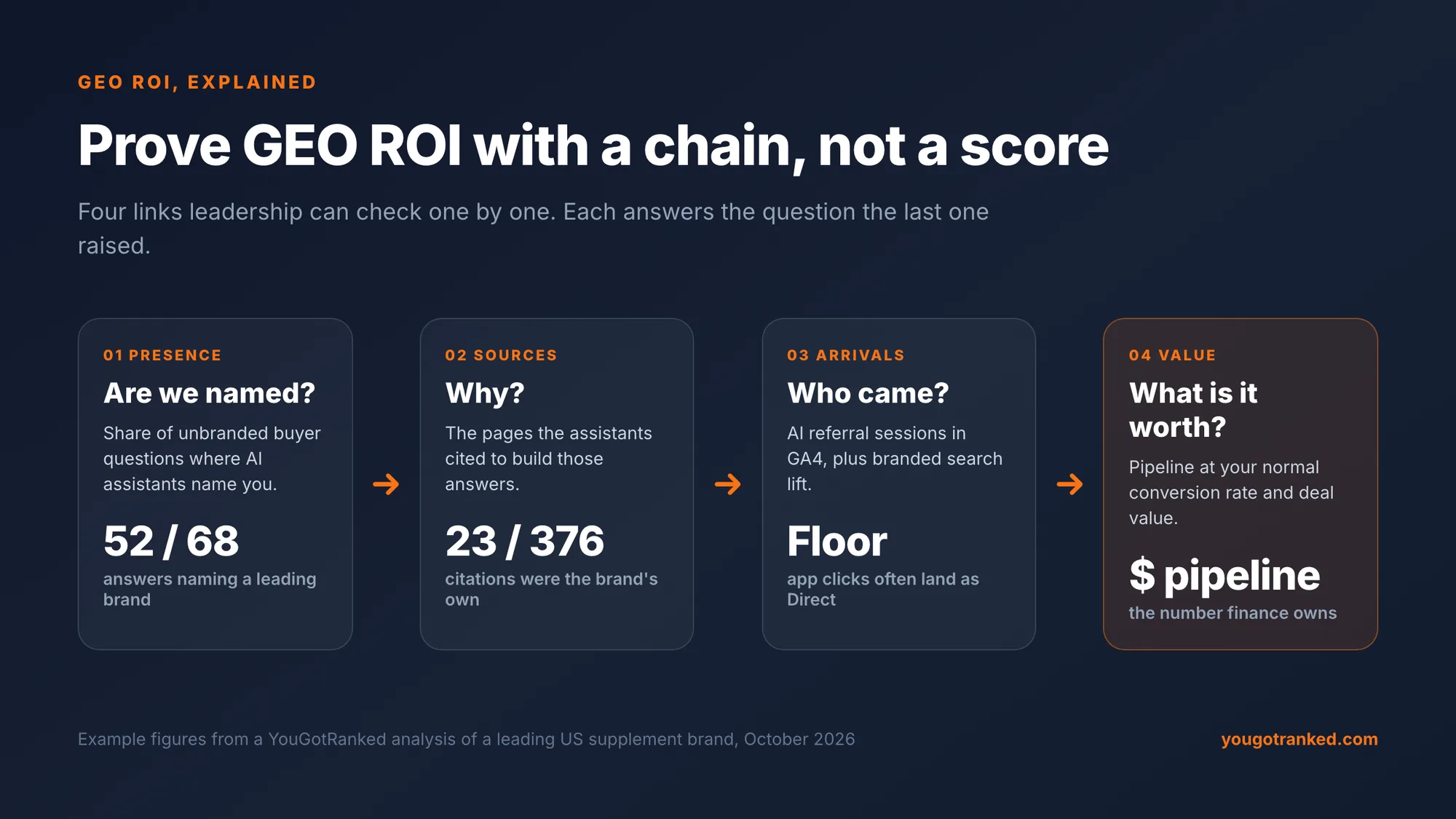
To prove GEO ROI to leadership, report a chain of four numbers rather than one score: how often AI assistants name you on buyer questions, which sources they cite to do it, how many sessions arrive from AI referrers, and what those sessions are worth in pipeline. Each link is measured separately, each can be checked, and the last one is a figure finance already uses. A visibility score on its own is not ROI. It is the first link.
Key takeaways
- 1GEO ROI is a chain, not a score. Presence, sources, arrivals and value, each measured on its own and each answering the question the last one raised.
- 2Last-click analytics undercounts AI search badly. Most answers produce no click, and app clicks often land as Direct. Treat AI referral sessions as a floor.
- 3Report unbranded questions separately. A question containing your name returns your name. The growth number is presence on questions buyers ask before they know you.
- 4Sources turn a report into a plan. The cited pages tell leadership why visibility moved and what to do next, with an owner and a date.
- 5Show replacement cost beside value. What the same visits would cost in Google Ads is the one number nobody in the room can dispute.
Terms in this piece
New to the acronyms? Each term below links to our field guide with plain-English definitions and how YouGotRanked scores them.
Why GEO ROI is harder to prove than SEO ROI
SEO reporting rests on three things Google hands you for free: the query, the click, and the landing page. Generative engine optimization loses all three at once.
The query is gone. AI assistants do not pass the prompt. There is no Search Console for ChatGPT, so you cannot see which question produced a recommendation. We wrote up why, and what to track instead, in There Is No Search Console for AI Prompts.
The click is rare. Most AI answers resolve the question on the page. When Pew Research tracked the real browsing of 900 US adults in 2025, people clicked a traditional result 8% of the time on searches with an AI summary, against 15% without one, and clicked a source cited inside the summary about 1% of the time. Influence happens without a visit.
The referrer is unreliable. When a click does happen from the ChatGPT or Gemini apps, it frequently arrives with no referrer and lands in analytics as Direct. Your AI referral count is a floor, not a ceiling.
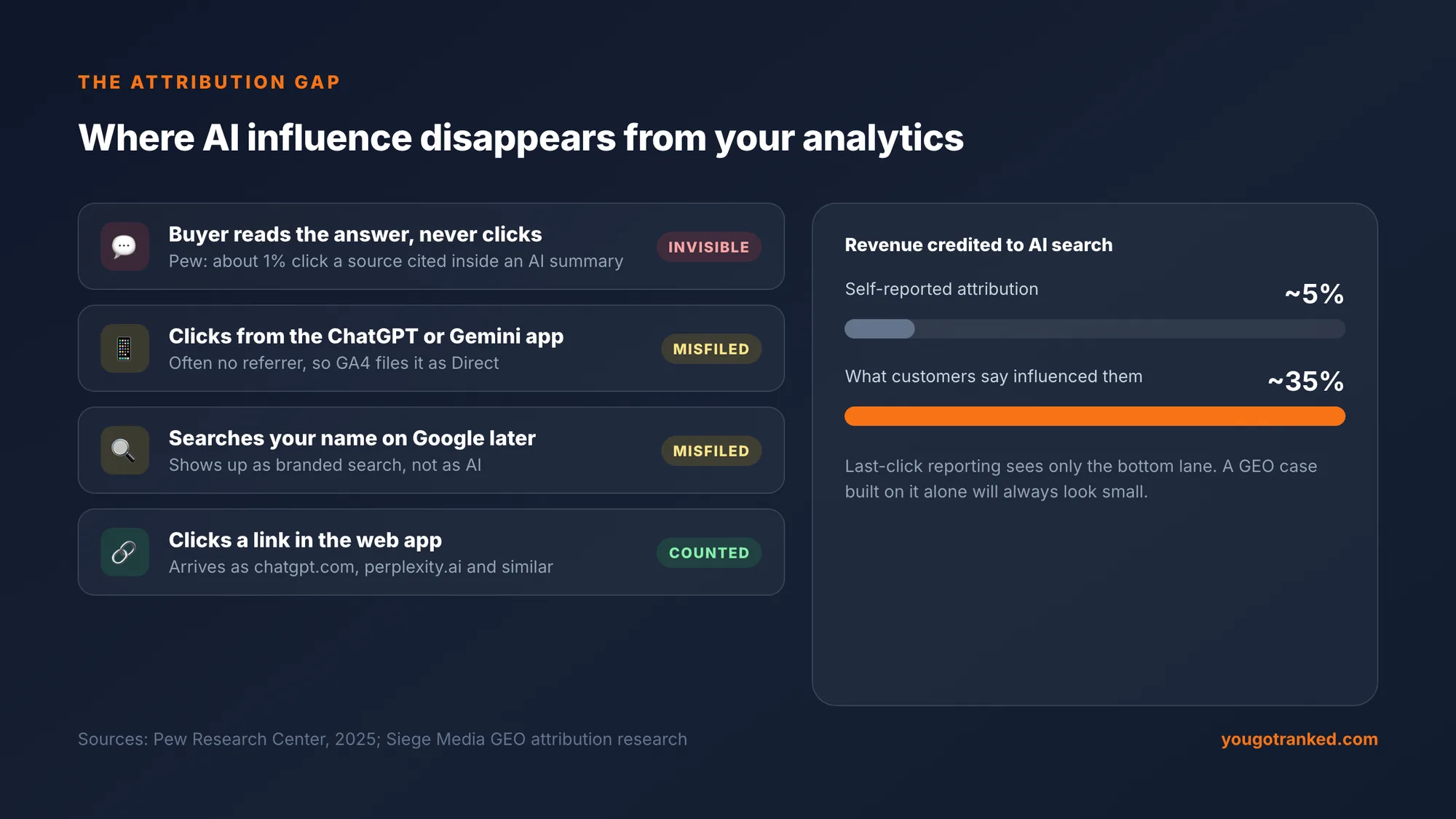
Siege Media's attribution research puts a number on the gap from the other side: self-reported attribution typically credits around 5% of revenue to AI search, while customers asked directly say it influenced closer to 35%. Whatever the exact figure in your business, the direction is the same. A GEO case built on last-click alone will always look small, and leadership will reasonably ask why it is funded.
The three questions leadership is really asking
Every GEO review meeting, however it is framed, is trying to answer three questions in order. A report that skips one gets stuck on it.
"Are we losing?" Do AI assistants name us when buyers ask about our category, and do they name competitors instead? This is a visibility question, and it is the one a dashboard can answer.
"What do we do about it?" Which specific actions would change the answer, who owns them, and when do they land? This is the question most dashboards cannot answer, because they report the score and not its causes.
"What is it worth?" If we fix it, what changes in pipeline, and is it more than we are spending? This is the finance question, and it needs a number finance already trusts.
The four-link chain is built to answer these three in sequence.
The four-link chain
Present GEO as a chain where each link feeds the next. Leadership can challenge any link, and every link has its own evidence.
Framework
From AI visibility to pipeline
1. Presence. Of the buyer questions you track, how many does each AI assistant answer by naming you? Reported as a share, per engine, against named competitors. The leading indicator, and the answer to "are we losing?"
2. Sources. Which pages the assistants cited to build those answers, and how many are yours. The cause. It tells you why presence moved and answers "what do we do?"
3. Arrivals. Sessions from AI referrers in GA4, branded search lift in Search Console, and self-reported "how did you hear about us" answers. The traffic evidence.
4. Value. Conversions and pipeline from those sessions, at your normal conversion rate and deal value, set against what you spend. The answer to "what is it worth?"
The order matters. Lead with link 4 and leadership asks why it is so small, because last-click undercounts it. Lead with link 1 and they ask what it is worth. Walk the chain and each number answers the question the previous one raised.
Link 1: presence, measured on a fixed question set
Presence is the share of tracked buyer questions where an AI assistant names you. It sounds simple, and it is where most GEO reporting goes wrong, for three reasons.
Fix the questions
The most common mistake is changing the questions. If the prompt set moves from month to month, a score change can mean visibility moved or the exam changed, and you cannot tell which. Leadership will notice the first time a number jumps for no reason, and the report loses its credibility from that meeting on.
Track the same buyer questions every cycle, on the same engines, with the same competitors. Add questions deliberately and log the date you did. Then a move in presence means your visibility moved.
How many questions? Enough to cover each product line and the main ways buyers ask: recommendations ("which providers would you suggest"), comparisons ("X or Y for a remote team"), and problem-led questions ("how do I fix…"). For most companies that is 30 to 100 questions. Fewer than 20 and a single answer changing moves the score several points.
Sample each question more than once
AI answers vary. Ask ChatGPT the same question twice and you can get two different shortlists. A single run per question is a sample of one, and it will make your trend line noisy enough that leadership stops trusting it. Run each question several times per cycle and report the share of runs that name you. The trend that survives that averaging is the real one.
Separate branded from unbranded
A question containing your name will almost always return your name. That measures recognition, not visibility. Mixed into one score, branded questions inflate the number and hide the gap that matters.
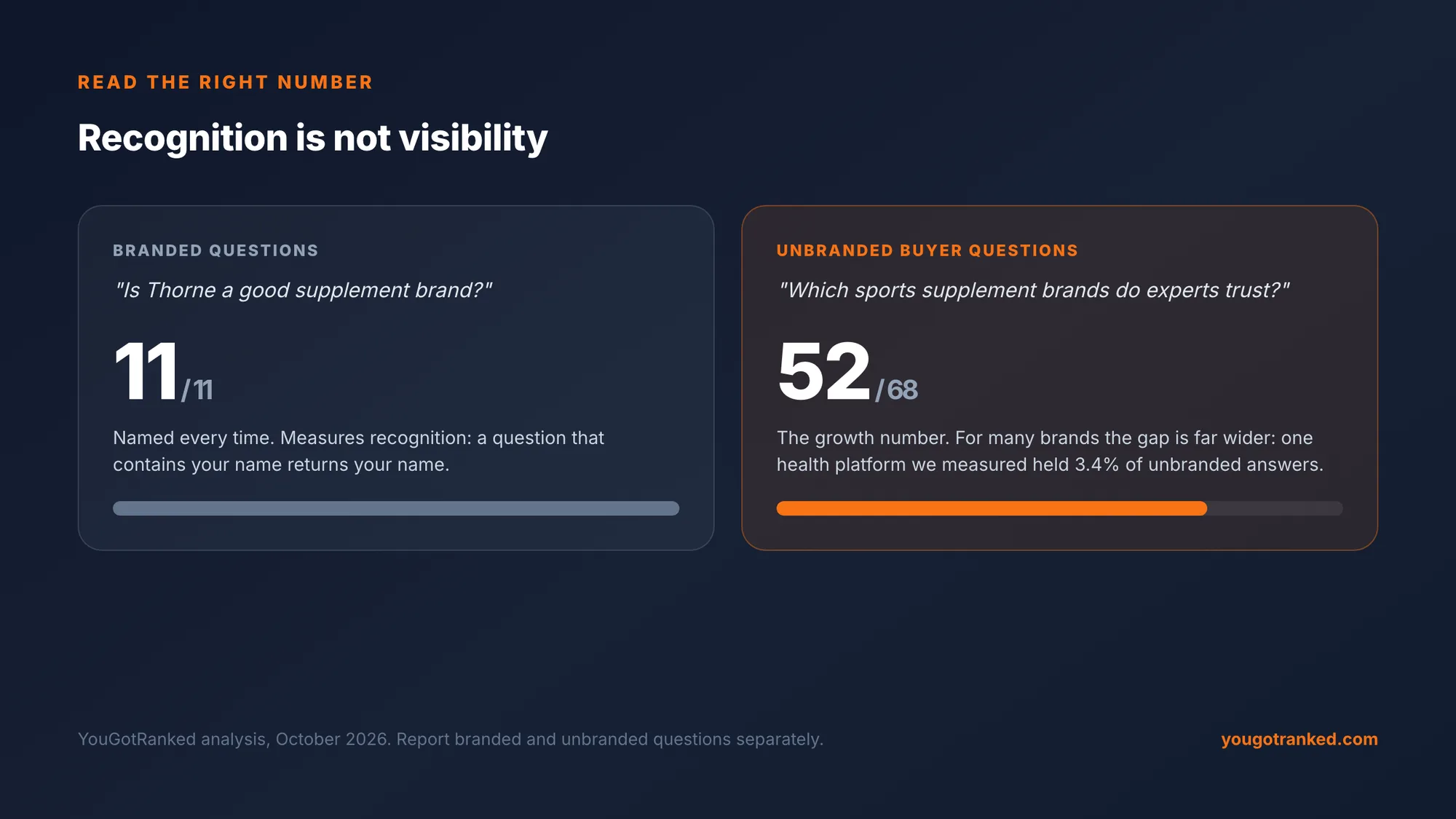
Here is what that looks like on a real report. This is the summary panel from a YouGotRanked analysis of Thorne, a leading US supplement brand, run this month:
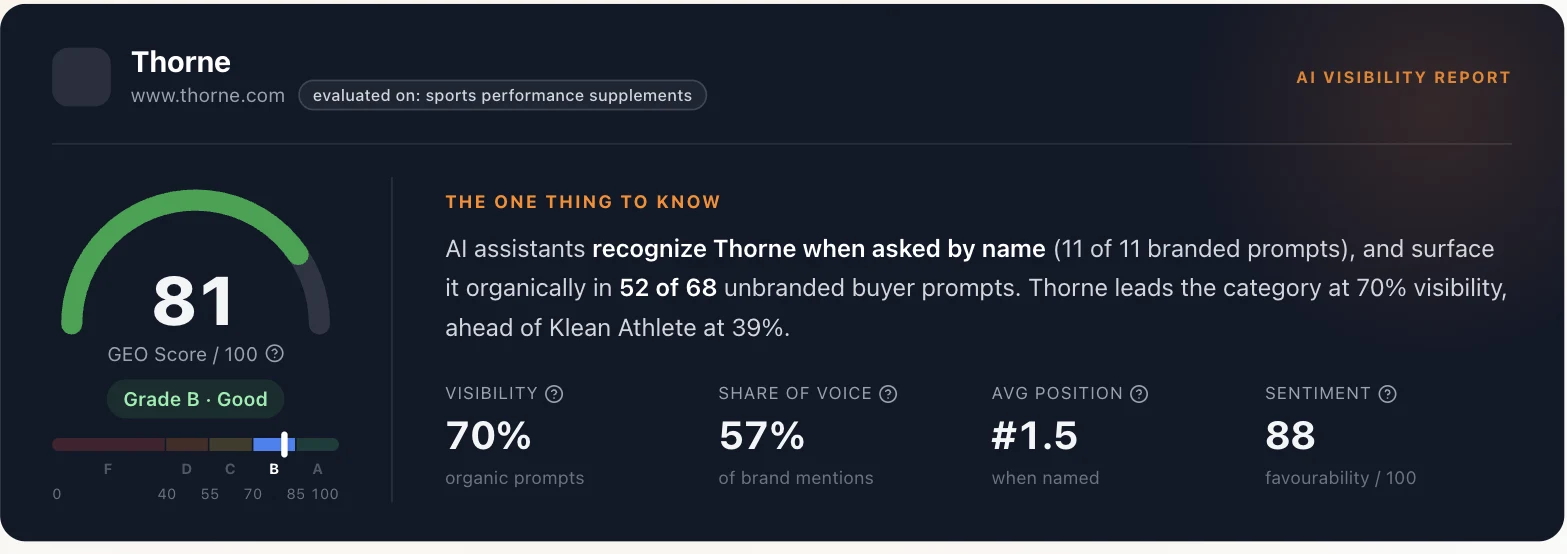
Thorne is a strong example because both numbers are healthy. For many brands they are not. One healthcare platform we measured was recognised on almost every question that contained its name, and held 3.4% of the answers to the questions buyers actually ask, while the category leader held 27.7%. A blended score would have reported something respectable and described neither.
Report per engine, against named competitors
Report presence for each assistant separately. The engines retrieve differently and the gap between them is often the most actionable finding: we have measured a well-known SEO brand at 95% visibility on ChatGPT and 44% on Google's AI Overview on the same day, with the same questions. And always show the same number for your top two or three competitors. Presence is only meaningful relative to who is being named instead.
Link 2: sources, the link most reports skip
Presence tells leadership whether you are named. Sources tell them why, and they are what turns a report into a plan.
Every answer from ChatGPT, Perplexity, Gemini and Google's AI Overview is assembled from pages the engine retrieved. Those pages are listed as citations. Counting them, by domain and by type, shows which parts of the web are shaping what assistants say about your category, and how much of it you control.
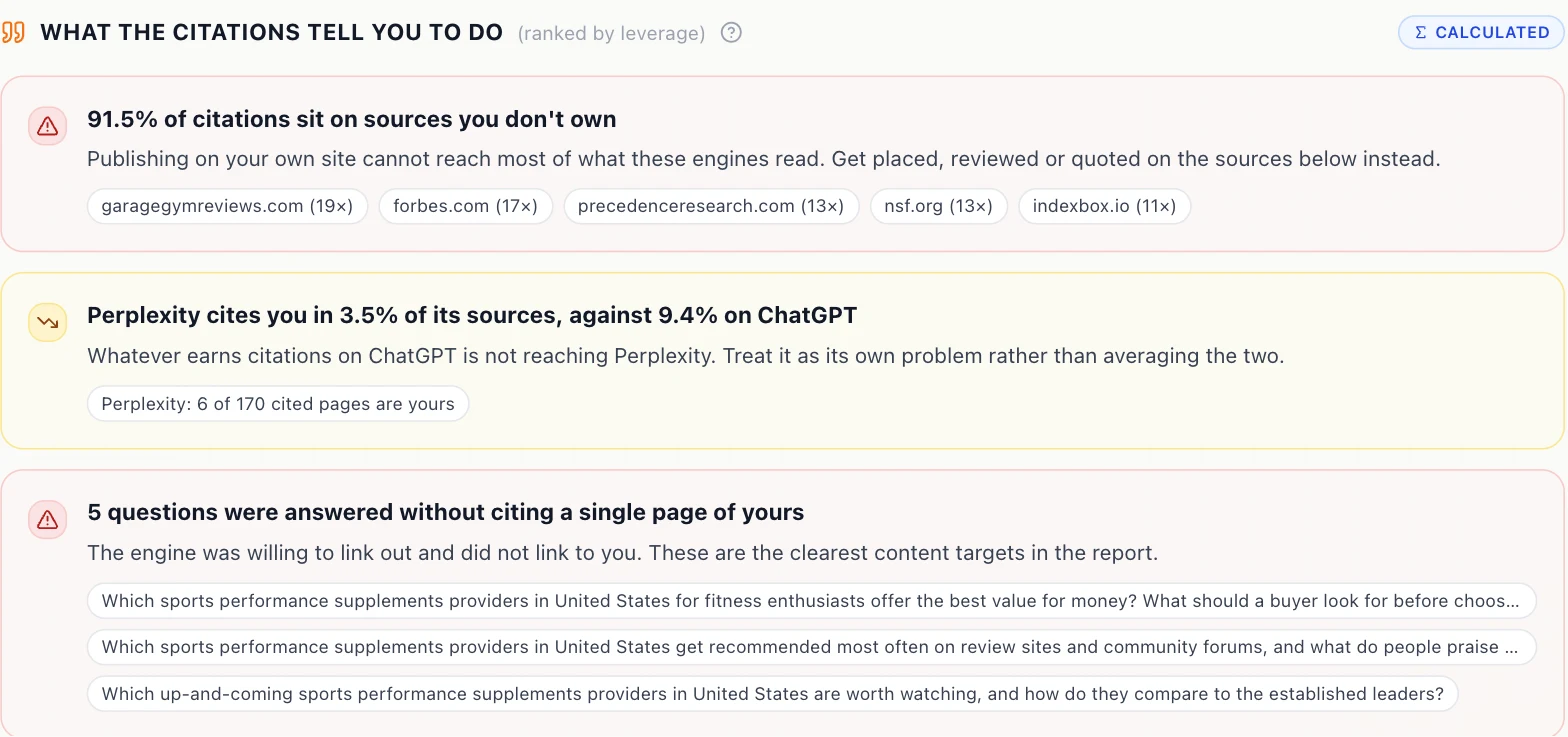
In the Thorne analysis, 52 of 68 buyer answers named the brand, a strong presence score. Of the 376 sources those answers were built from, 23 were the brand's own pages. The rest came from reviewers, certifiers, market-research sites and media. That is a very different strategic picture from the presence score alone: the visibility is real, and it is borrowed. The budget question becomes which third-party relationships to protect, and which of the five uncited questions to target first.
Group sources by type, because each type has a different owner and a different action:
| Source type | Example | Who owns the action | Typical action |
|---|---|---|---|
| Your own pages | thorne.com | Content | Make the answer quotable: direct answers, comparison tables, specs |
| Independent reviewers | garagegymreviews.com | PR / partnerships | Get tested, listed and quoted; supply data |
| Media | forbes.com | PR | Contributor roundups; the byline is the target, not the masthead |
| Certifiers and regulators | nsf.org, usada.org | Product / compliance | Earn and publicise the certification |
| Community | Reddit, forums | Community / brand | Genuine participation where buyers ask |
| Marketplaces and directories | G2, Amazon | Channel | Complete, current, well-reviewed listings |
Go one level deeper where you can. On YouGotRanked reports the Citation Engine names the author on every cited page. In one healthcare category we found a single writer on one site cited more than the two largest booking platforms combined. That is not a content programme. It is one relationship and one email, and it is exactly the kind of finding that gets a GEO budget renewed.
Link 3: arrivals, and how to count them honestly
Arrivals are the traffic evidence. Use three sources together, and say plainly that each one undercounts.
AI referral sessions in GA4
By default GA4 lumps AI assistants into Referral alongside every other website, which makes them impossible to report on. Give them their own channel.
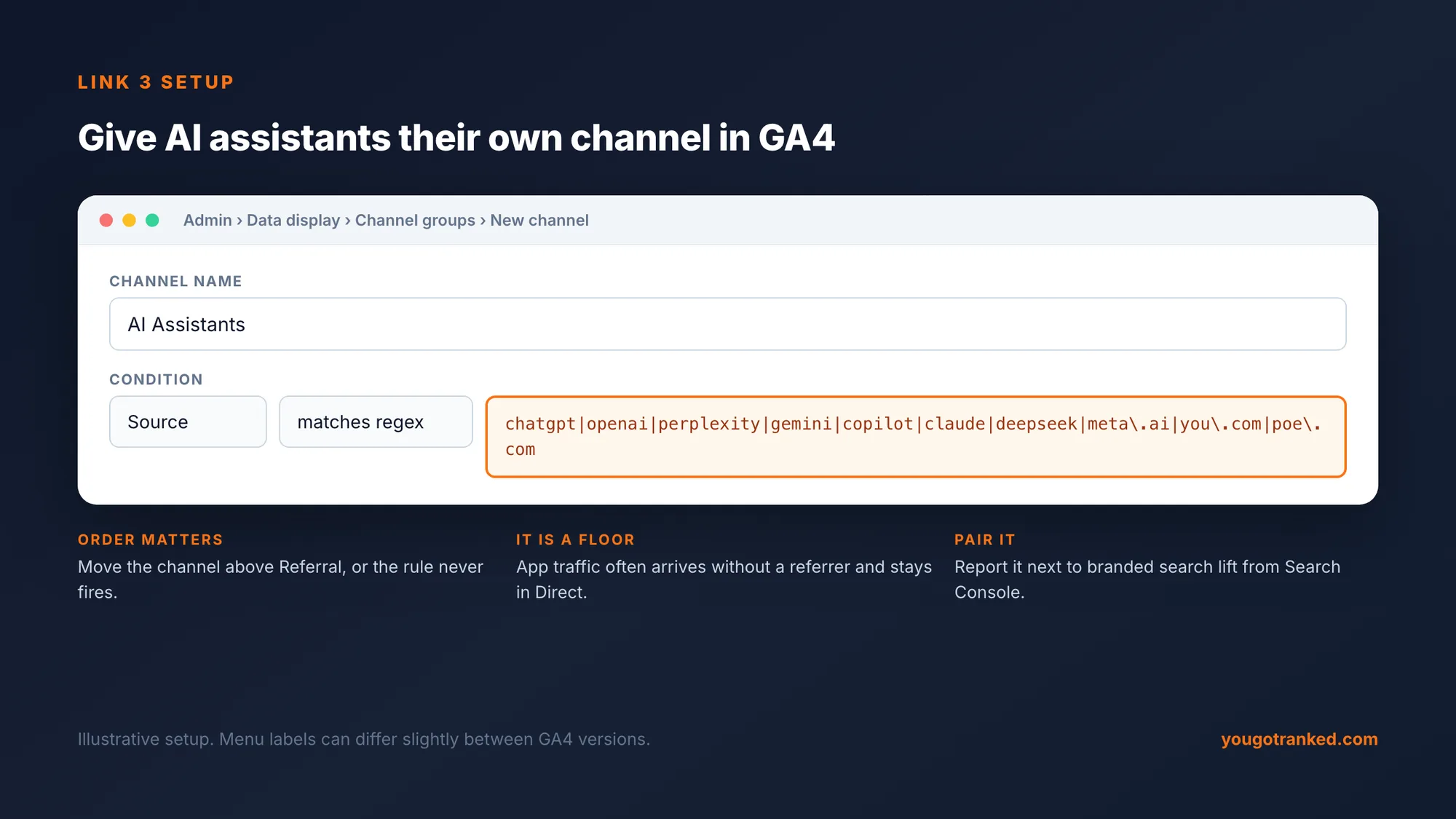
- In GA4, go to Admin → Data display → Channel groups and copy the default channel group.
- Add a channel called AI Assistants.
- Set the condition to Source matches regex and paste:
chatgpt|openai|perplexity|gemini|copilot|claude|deepseek|meta\.ai|you\.com|poe\.com - Move the new channel above Referral. Channels are evaluated in order, so if Referral comes first it claims the traffic.
- Save, and use the new channel group in your acquisition reports and explorations.
Report the monthly total and the trend, and label it a floor every time it appears. Traffic from the ChatGPT and Gemini apps often arrives without a referrer and stays in Direct.
Branded search lift in Search Console
When an assistant recommends you, a share of people go to Google and search your name. Track branded impressions and clicks month on month in Search Console, and look for lifts that follow visibility gains. On its own this is corroboration, not proof of causation, so present it next to link 1 and only claim a connection where the timing lines up.
Google's new Generative AI report
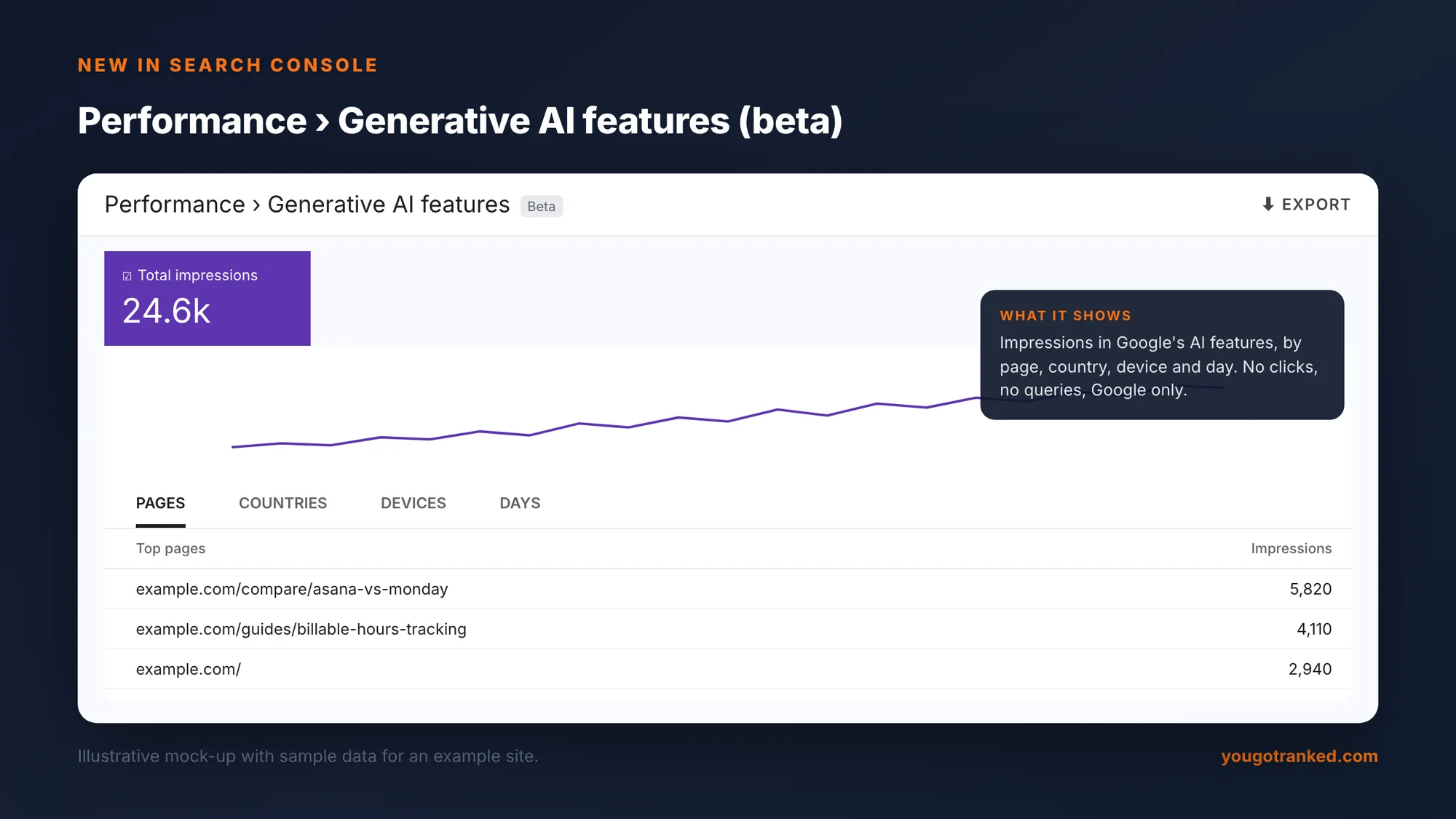
Search Console now has a beta Generative AI features report under Performance, showing impressions your pages earned in Google's AI features, broken down by page, country, device and day. It covers Google only, and impressions only, but it is the first first-party number Google has given site owners for its AI surfaces, and it belongs in link 3.
Ask the customer
Add "an AI assistant like ChatGPT" as an explicit option on your lead form's "how did you hear about us" field, and ask the same question on sales calls. It is the cheapest attribution data available, it captures influence that never produced a referral, and over a quarter it gives you a ratio you can apply to the GA4 floor.
Link 4: the calculation
Keep the formula simple enough to explain in one sentence, and show your inputs.
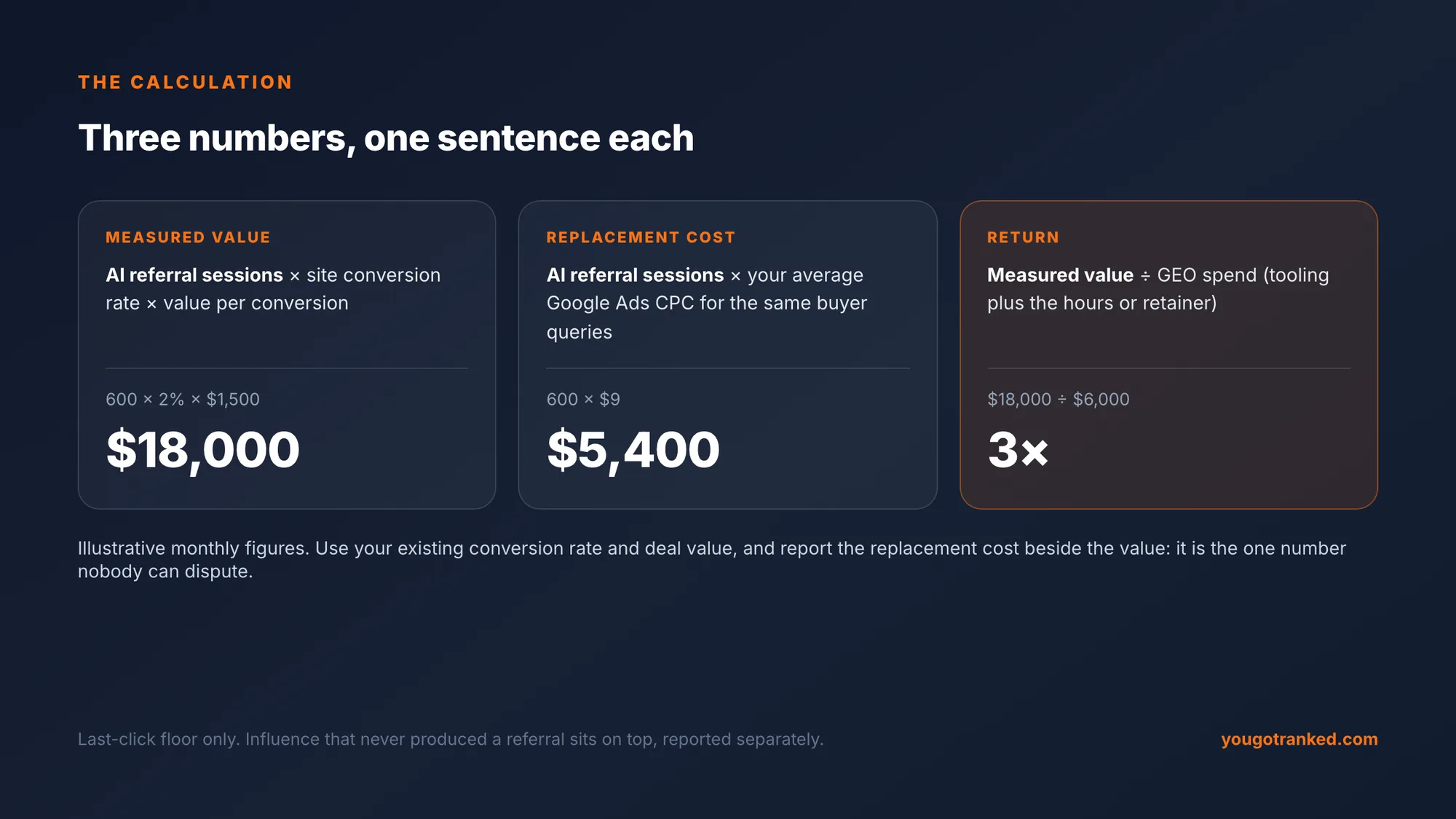
The worked example, step by step. A B2B company sees 600 sessions a month from its AI Assistants channel. Its site converts at 2% to a qualified lead, and a qualified lead is worth $1,500 in pipeline at its close rate.
- Measured value: 600 × 0.02 × $1,500 = $18,000 a month in pipeline.
- Replacement cost: its buyer queries cost $9 a click in Google Ads, so buying the same 600 visits would cost $5,400.
- Return: if GEO costs $6,000 a month all in, tooling plus the hours or retainer behind the work, the measured return is 3x on pipeline, before any of the influence last-click misses.
Present a range, not a point. Leadership trusts a model that shows its sensitivity:
| Scenario | AI sessions / month | Conversion rate | Pipeline / month | Return on $6,000 |
|---|---|---|---|---|
| Conservative (GA4 floor only) | 600 | 1.5% | $13,500 | 2.3x |
| Expected | 600 | 2.0% | $18,000 | 3.0x |
| With self-reported uplift (1.5x) | 900 | 2.0% | $27,000 | 4.5x |
Two rules make this survive scrutiny. Use your existing conversion rate and deal value, not a special one for AI traffic, unless you have measured it. And always present the replacement cost next to the value figure, because it is what the same attention would cost to buy.
Leading and lagging indicators
GEO work moves the chain from the top down, and the links move at different speeds. Set expectations accordingly, or leadership will judge month-two work on a month-six metric.
| Indicator | Link | Moves within | What it tells leadership |
|---|---|---|---|
| Cited-source changes | 2 | Weeks | The work is landing where the engines read |
| Unbranded presence | 1 | 1–3 months | Assistants are starting to name you |
| Competitor presence | 1 | 1–3 months | Whether you are gaining share or the category is shifting |
| AI referral sessions | 3 | 2–4 months | Recommendations are turning into visits |
| Branded search lift | 3 | 2–6 months | Recommendations are creating demand |
| Pipeline from AI sessions | 4 | 3–6 months | The business case |
Why most AI visibility dashboards stop being read
A pattern we hear constantly, and one that turns up word for word in search queries: "We've been tracking our AI visibility with a prompt monitoring tool for a few months, but nobody looks at it anymore and no actions come out of it."
The dashboard dies for a predictable reason. It reports link 1 only. A presence score with no sources behind it cannot tell anyone what to do, so after the first two meetings it becomes a number that goes up or down for reasons nobody can explain. Leadership stops asking about it, then the team stops opening it.
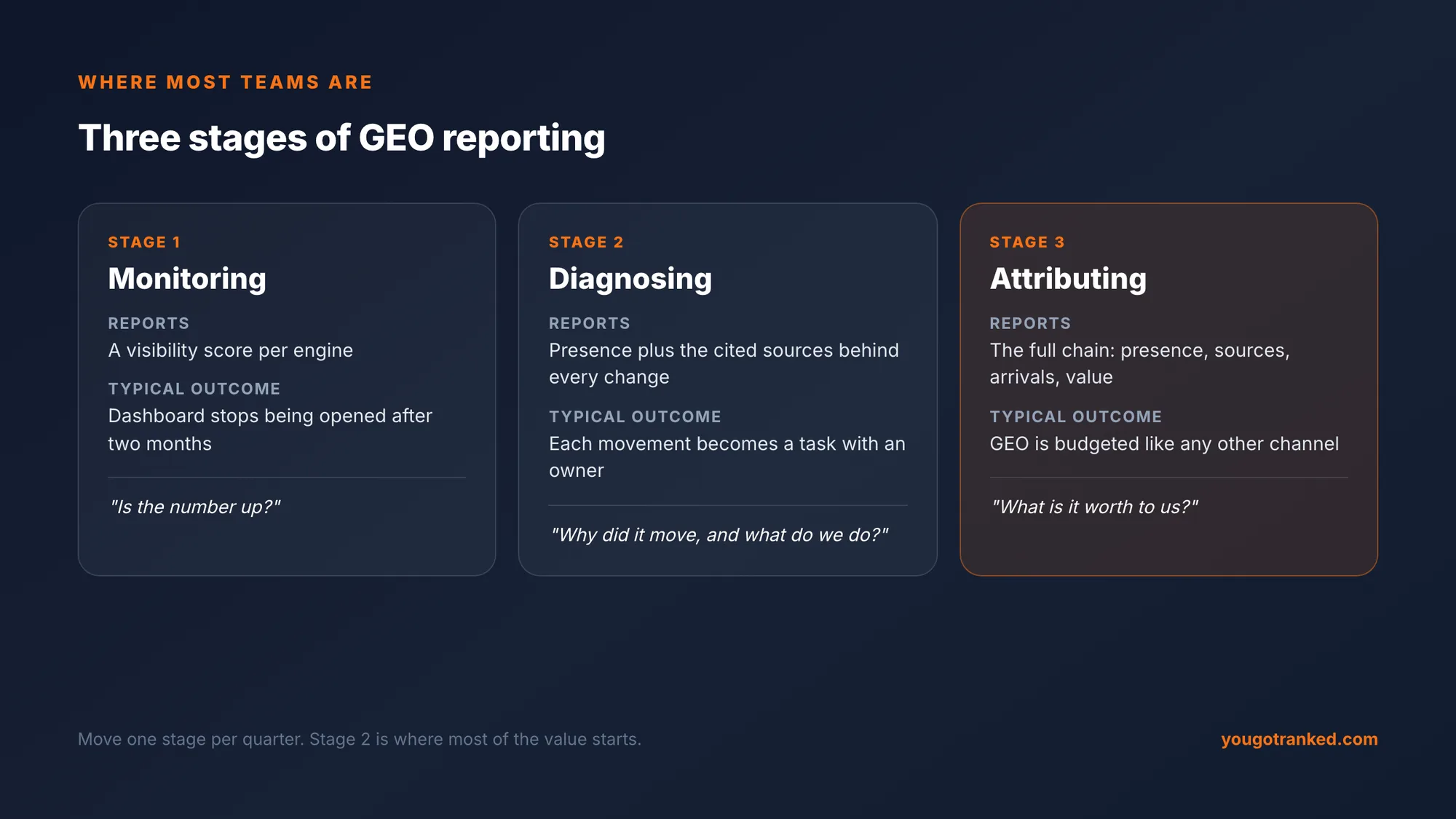
Three changes bring it back to life:
Attach a source to every movement. When presence drops on a question, the report says which cited page changed. That turns a worry into a task.
Give every finding an owner and a date. "Get listed on the two review sites that carry 30% of citations, owner PR, by end of month" is something leadership can track. "Visibility down 4 points" is not.
Report monthly, against the same questions. Weekly is noise for leadership. Monthly, on a fixed set, shows a trend they can hold you to.
The one-page monthly report
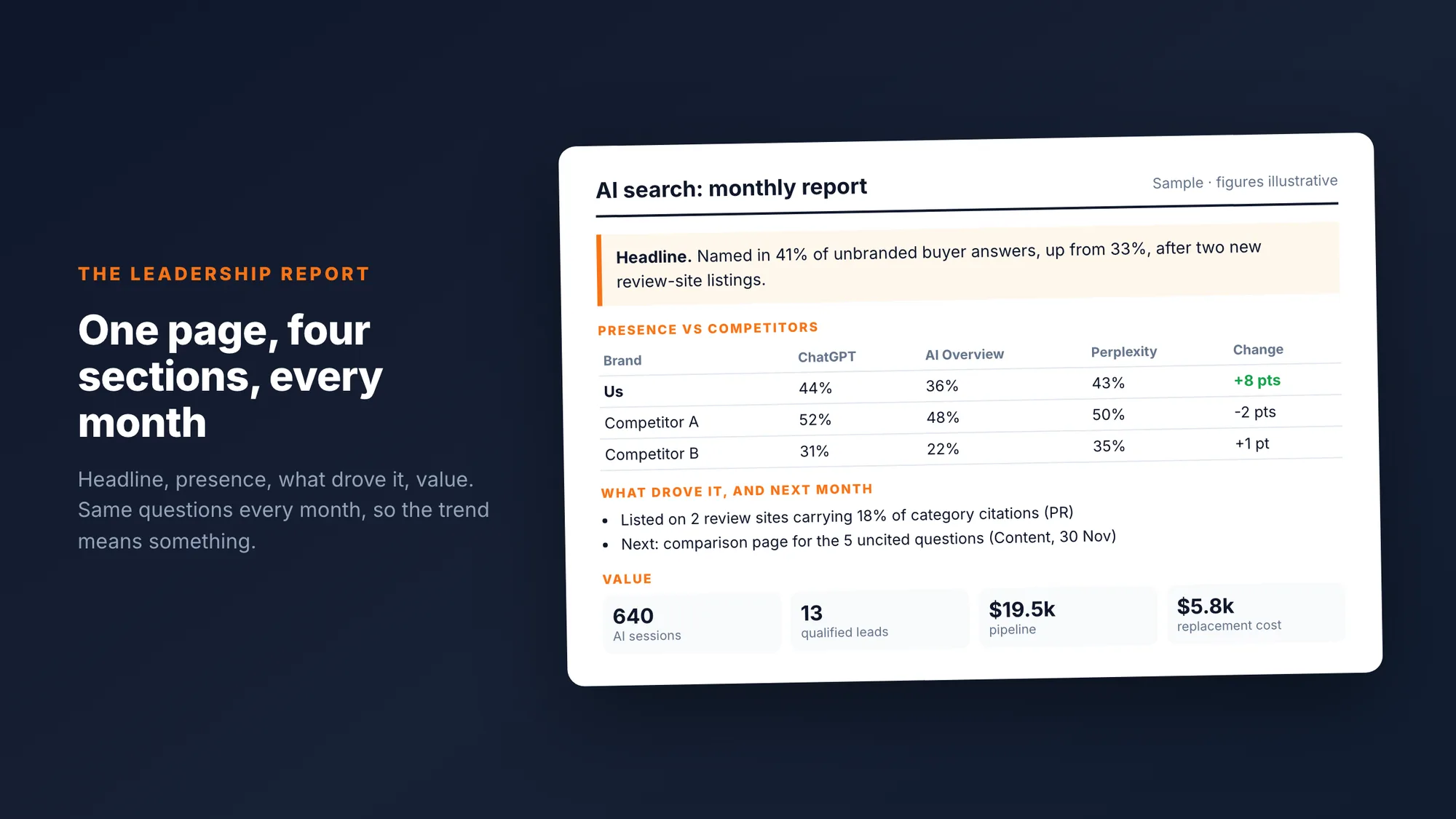
This is the format we recommend for a leadership audience. It fits on one page and answers the three questions in order.
Framework
One page, four sections
1. Headline. One sentence: what moved, and why. "Named in 41% of unbranded buyer answers, up from 33%, after two new review-site listings."
2. Presence. Share of unbranded buyer questions where each assistant names you, against your top competitors. Month on month.
3. What drove it. The cited sources that changed most, the actions that caused it, and next month's three actions with owners and dates.
4. Value. AI sessions, conversions, pipeline at your standard rates, and the replacement cost in paid search. Branded search trend as corroboration.
A 90-day plan to your first ROI number
| Days | Do | Leadership sees |
|---|---|---|
| 1–30 | Fix a question set of 30–100 buyer questions; baseline presence per engine against 3 competitors; set up the GA4 AI Assistants channel; add the AI option to your lead form | A baseline: where you stand and who is named instead |
| 31–60 | Map cited sources by type; act on the top three (one owned page, one reviewer, one listing); start the monthly one-page report | The first report with causes, owners and dates |
| 61–90 | Re-measure on the same questions; compute measured value and replacement cost from GA4; apply the self-reported ratio | The first ROI range, with every input visible |
The objections you will hear, and how to answer them
If
"AI answers are random. Why trust a score?"
Start with
Fixed questions, multiple runs
Each question is sampled several times per cycle and the share of runs is reported. Randomness averages out; the trend that survives is real.
If
"The traffic is tiny."
Start with
Show the floor, then the gap
GA4 sees the bottom lane only. Pew puts clicks inside AI answers near 1%. Show the self-reported ratio beside the GA4 number.
If
"Is this not just SEO?"
Start with
Show the source split
When most citations sit on pages you do not own, ranking your own pages cannot reach them. Different inputs, different owners.
If
"How do we know it was us and not the market?"
Start with
Competitor presence
If your presence rose and competitors held flat on the same questions, the change is yours. If everyone rose, the category moved.
What not to claim
Leadership trust is lost in one meeting and rebuilt over quarters, so be precise about what each number can and cannot support.
- Do not present a visibility score as revenue.
- Do not add estimated influence to measured pipeline in the same total. Show it separately, labelled as an estimate.
- Do not compare scores from two different tools, or from two different question sets, as if they were one trend.
- Do not claim a branded search lift was caused by AI visibility unless the timing and the presence data line up.
The case is stronger for its restraint. A floor that is clearly a floor, with an honest note on what it misses, persuades finance more than an inflated total does.
Get all four links in one place
YouGotRanked tracks a fixed set of buyer questions across ChatGPT and other AI providers, shows every source behind every answer with its author, and puts Search Console, GA4 and AI referral sessions in the same workspace. Start with a free analysis of your brand.
Analyze My Brand for Free →
FAQ
How do I prove ROI from GEO to leadership? Report a chain of four numbers: presence (how often AI assistants name you on unbranded buyer questions), sources (which pages they cite), arrivals (AI referral sessions in GA4, branded search lift and self-reported attribution), and value (pipeline from those sessions at your standard rates). Add the replacement cost, what the same visits would cost in paid search, as the figure nobody can dispute.
How do I calculate AI search ROI? Multiply AI referral sessions by your site conversion rate and your average value per conversion to get measured value, then divide by your GEO spend (tooling plus the hours or retainer behind the work). Present the replacement cost, sessions multiplied by your average cost per click in Google Ads, alongside it, and show a conservative-to-upside range.
How do I track AI referral traffic in GA4? Create a custom channel group with a channel called AI Assistants, set the condition to source matches a regex of AI assistant domains such as chatgpt, perplexity, gemini, copilot and claude, and place it above Referral so it is evaluated first. Treat the result as a floor, because app traffic often arrives without a referrer.
Why does GA4 undercount AI traffic? Clicks from the ChatGPT and Gemini apps often arrive without a referrer and are recorded as Direct, and most AI answers resolve the question without any click at all. AI referral sessions in GA4 are a floor on AI influence, not the total.
What is the most important GEO metric for leadership? Presence on unbranded buyer questions, tracked on a fixed question set against named competitors. Branded questions measure recognition and inflate the score; the unbranded number is the one tied to new demand.
How long does GEO take to show ROI? Cited sources can change within weeks, unbranded presence typically moves over one to three months, and AI referral sessions and pipeline follow over two to six months. Set leadership expectations on the leading indicators first.
Why do teams stop using their AI visibility dashboards? Most report a visibility score without the sources behind it, so nobody can tell what caused a change or what to do about it. Attaching the cited sources to every movement, and an owner and date to every finding, turns the report back into a plan.
Is generative engine optimization worth it? It is worth it where buyers in your category already ask AI assistants for recommendations and competitors are being named instead of you. Measure presence and sources first; if you are absent on unbranded questions and the cited sources are reachable, the case usually makes itself within a quarter.
Go deeper: How to Connect Google Search Console to ChatGPT · There Is No Search Console for AI Prompts · What Is Generative Engine Optimization? · The 10 Best AI Visibility Tools