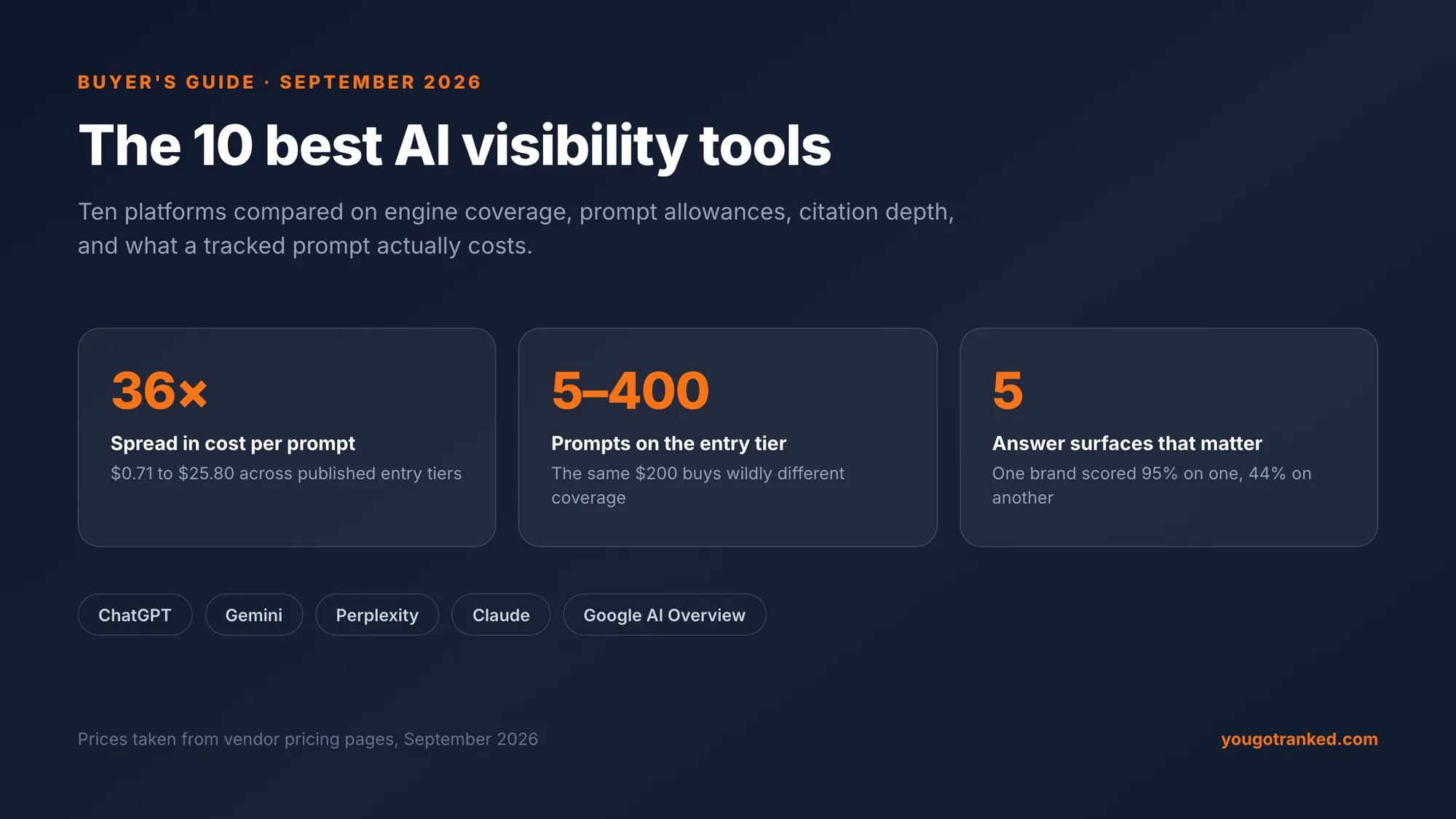
An AI visibility tool tells you whether ChatGPT, Gemini, Perplexity, and Google's AI Overview recommend your brand when someone asks a question in your category — and which sources they used to decide. Ten platforms are worth shortlisting in 2026. They are not interchangeable: the cheapest entry tier tracks 5 prompts a month, the widest tracks 400, and the same $200 buys you anywhere from 8 tracked prompts to 280 depending on which vendor you hand it to.
Key takeaways
- 1The spread on cost per tracked prompt is 36×. On published entry tiers it runs from $0.71 (Scrunch) to $25.80 (Ahrefs Brand Radar) per prompt per month.
- 2Prompt volume matters more than price. A 5- or 15-prompt plan measures your prompt selection, not your visibility — most categories generate hundreds of distinct buyer questions.
- 3Engine coverage is metered, not included. Profound's $99 entry tier is ChatGPT only; AthenaHQ meters by credit, where one prompt on nine models spends nine credits.
- 4Citation depth is the real 2026 differentiator. A domain list is baseline; individual URLs are better; resolving those pages to the journalists who wrote them is rare across the category.
- 5Scores are samples, not observations. AI answers vary run to run, so any tool that queries each prompt once a day is reporting a coin flip. Ask every vendor how many times they sample.
Terms in this piece
New to the acronyms? Each term below links to our field guide with plain-English definitions and how YouGotRanked scores them.
What an AI visibility platform actually does
The mechanics are the same everywhere, and knowing them makes the differences between vendors easy to read.
A platform holds a set of prompts — the questions a buyer would type into an assistant, like "best cold chain logistics provider in Europe" or "how do I test for vitamin D deficiency at home". On a schedule, it sends each prompt to each engine it supports, captures the full answer, and parses three things out of it: whether your brand was named, in what tone, and which URLs the engine cited as sources.
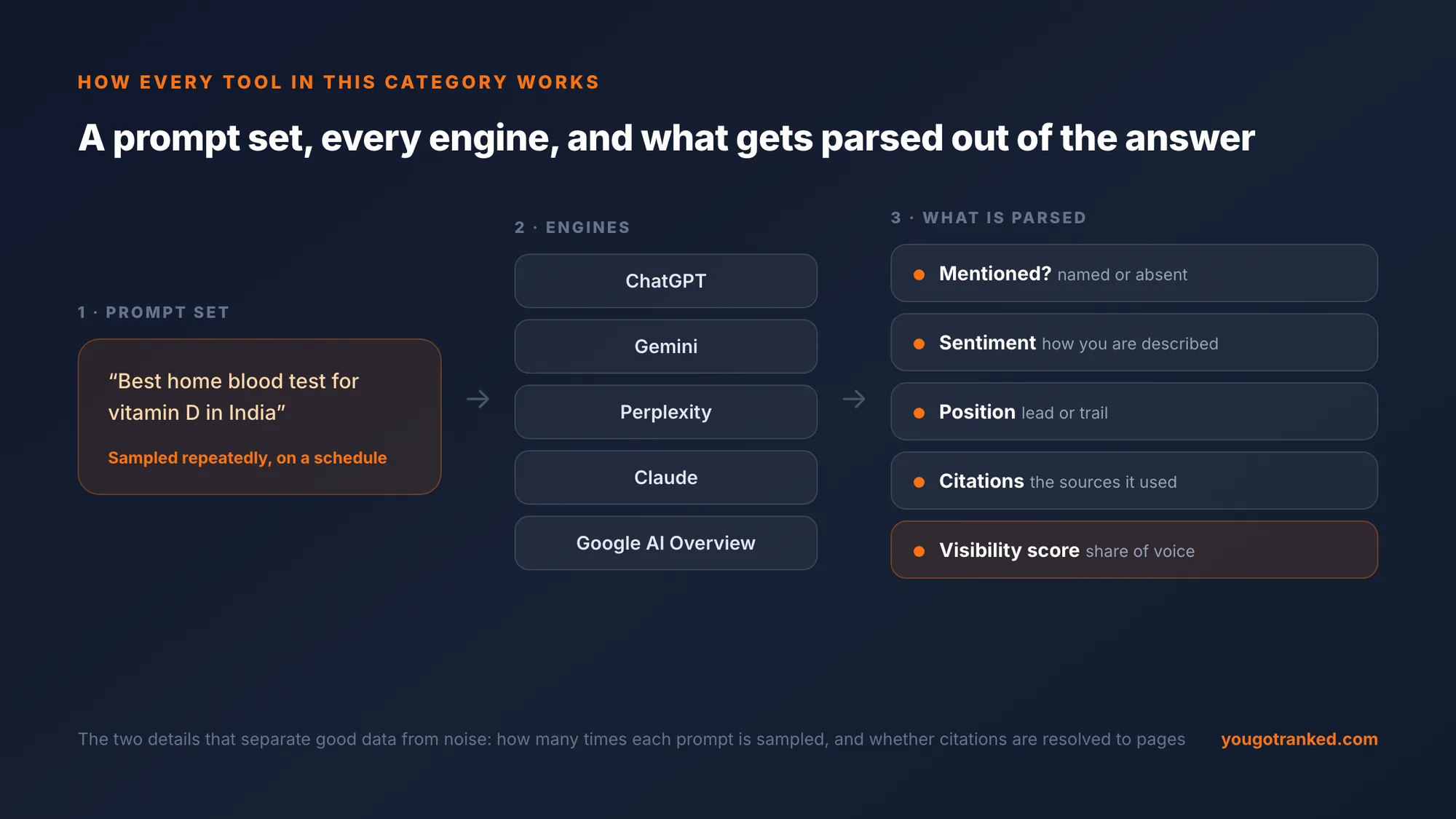
Roll that up over a few hundred prompts and you get the metrics the category has converged on: a visibility score or share of voice (in what share of answers you appear), sentiment, position (whether you lead the answer or trail it), and a citation ledger (the domains and pages the engines drew on).
Two details do most of the work in separating good data from noise.
The first is sampling. LLM answers are not deterministic. Ask the same question twice and one run names you, the next does not. A platform that queries each prompt once a day is reporting a coin flip as a measurement. Repeated sampling of the same prompt is what makes a score stable enough to report to a board or act on.
The second is whether the tool resolves citations. Being absent from an answer is a symptom. The cause is sitting in the sources the engine used instead — a roundup you are not in, a Reddit thread, a trade publication, a competitor's comparison page. A tool that shows only your score describes the symptom. A tool that shows the cited pages hands you the work.
Why AI visibility tracking is not rank tracking
The temptation is to treat this as rank tracking with a new results page. It is not, and the differences are structural.
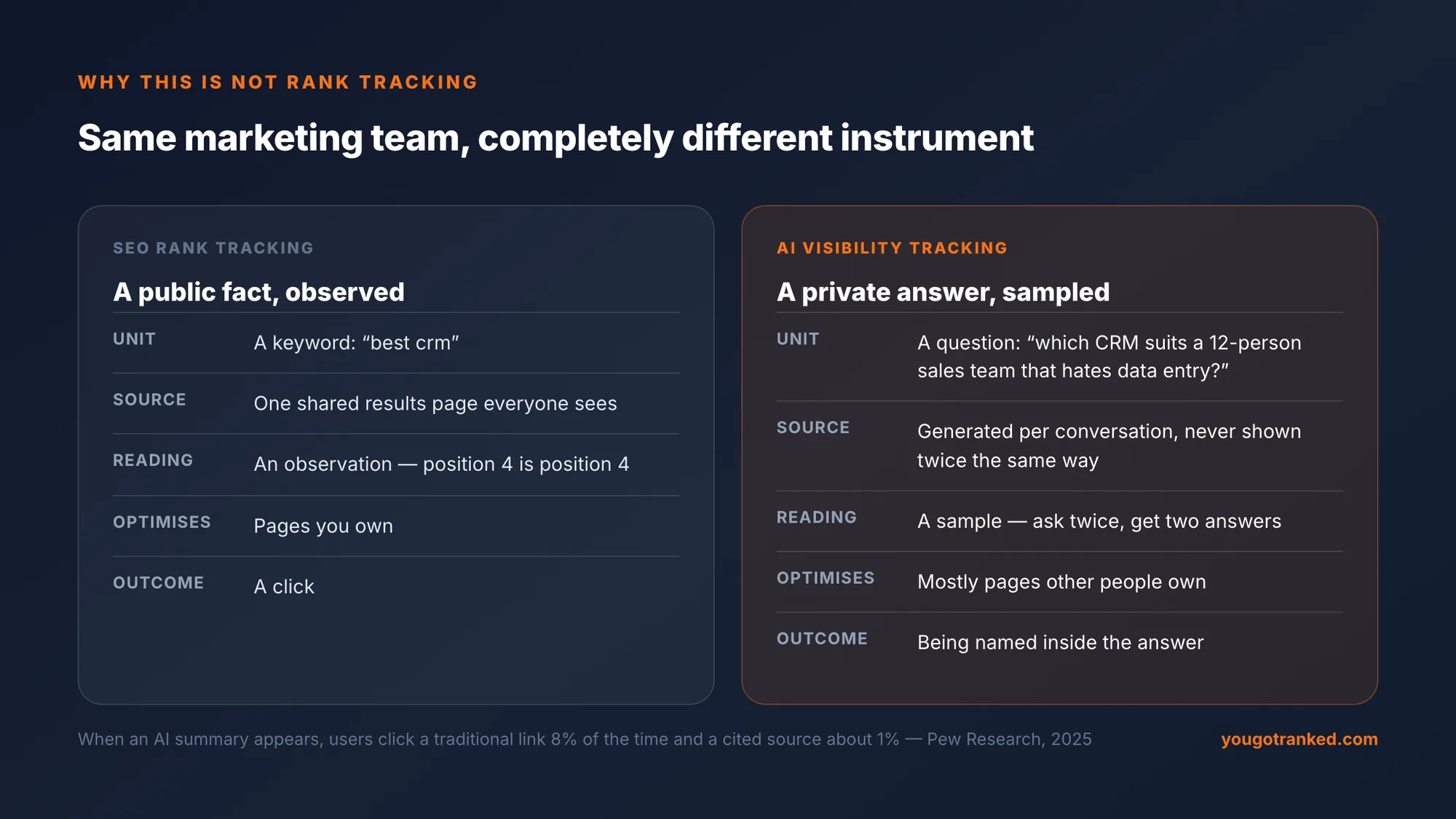
There is no results page to scrape. A ranking is a public fact about a shared page. An AI answer is generated per conversation, varies by phrasing, user history, and region, and is never shown to anyone else in exactly that form. Every number in this category is a sample, not an observation — which is why sampling design matters more than in SEO.
The unit is a question, not a keyword. People type "which CRM is best for a 12-person sales team that hates data entry", not "best crm". Prompt sets look nothing like keyword lists, and a tool that hands you 50 slots is asking you to guess which 50 questions matter in a space where buyers ask thousands.
Third-party sources dominate. In the reports we run, the overwhelming majority of cited pages belong to somebody else — review sites, forums, trade press, comparison roundups like this one. Traditional SEO optimises pages you own. AEO is mostly a question of what other people's pages say about you, which is a PR and content-placement problem wearing an SEO costume.
Clicks are not the outcome. Pew Research found that when a results page carried an AI summary, users clicked a traditional link 8% of the time, against 15% without one, and clicked a source cited inside the summary about 1% of the time. Being named inside the answer is the win. Traffic is a lagging and shrinking proxy for it.
What to look for when you compare them
How many prompts does the entry tier actually track?
This is where the value spread is widest, and it is the first number to ask for. Brand Radar on the Ahrefs Lite plan tracks 5 custom prompts. Otterly's $29 tier tracks 15. Scrunch's $250 Starter tracks 350. A category of any complexity generates hundreds of distinct buyer questions, and a 15-prompt sample cannot tell you whether you have a visibility problem or a prompt-selection problem.
Prompts tracked on each published entry tier
AthenaHQ is credit-metered: 3,600 credits across 9 models works out at roughly 400 prompts in one location. YouGotRanked's figure is prompt checks per analysis, with 5 analyses a month on Pro.Peec AI, Conductor, and BrightEdge do not publish a prompt allowance, so they are not plotted.
Source: Vendor pricing pages, September 2026
What does a tracked prompt cost?
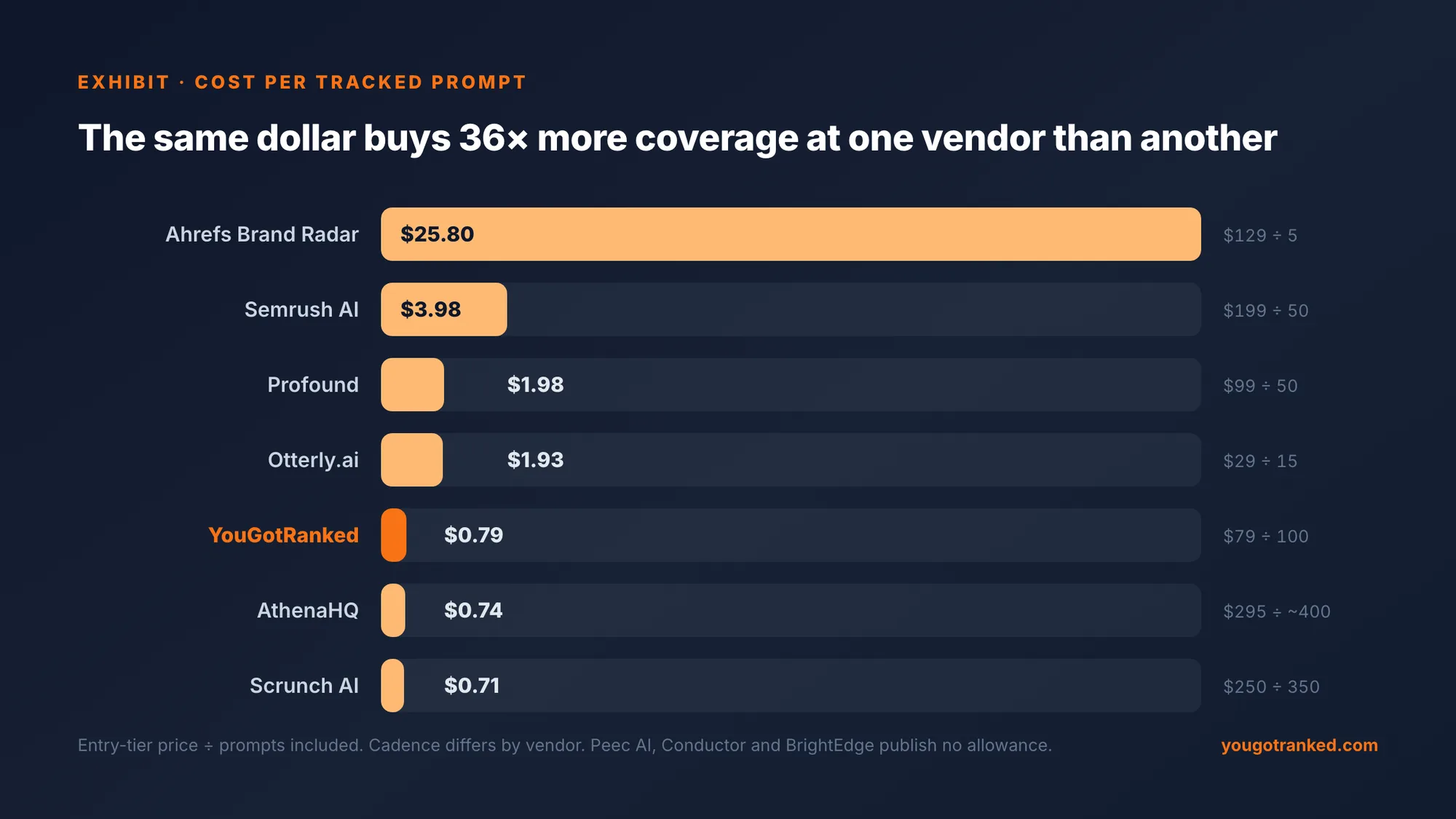
Divide the entry price by the prompts it includes and the ranking changes completely. The tools that look cheap on a pricing page are not always the ones giving you coverage, and the most expensive entry tier on this list is not the one with the biggest number on it.
Is engine coverage included, or metered?
Every vendor lists engines. Read the plan, not the homepage. Several platforms put ChatGPT-only on the entry tier and charge a multiple for Gemini, Perplexity, and Copilot — Profound's $99 Starter is ChatGPT alone, with three engines at $399. Others meter by credit, where one prompt on one model in one location is one credit, so "9 models" quietly divides your prompt budget by nine.
Google's AI Overview deserves a specific check, because it behaves differently from the chat assistants. In one report we ran, a single brand scored 95% visibility on ChatGPT and 44% on AI Overview on the same day with the same questions.
One brand, one day, two answer surfaces
A blended score here would have read about 70 and described neither surface accurately. Per-engine reporting is not a nice-to-have.
Source: YouGotRanked platform data
Can you see the sources — and who wrote them?
The strongest differentiator in 2026. Baseline is a list of cited domains. Better is the individual URLs with the engines that used them. Better still is who wrote those pages — because if a single journalist's article is being cited across four engines in your category, that is a named person to brief, not a keyword to target.
What happens after the dashboard loads?
Analytics-first platforms are consistently criticised for the same thing in review write-ups: they surface a great deal of signal and leave the interpretation to you. If your team does not have a GEO strategist, a raw feed of mentions becomes a report nobody acts on. Look for whether the tool produces a prioritised list of fixes, a content plan tied to real search demand, and a way to track whether the work moved the number.
The 10 best AI visibility tools, at a glance
| # | Tool | Best for | Prompts (entry) | Entry price | Free path |
|---|---|---|---|---|---|
| 1 | YouGotRanked | Teams who need the plan, not just the score | 100 per analysis | Free, then $79/mo | Full analysis, no card |
| 2 | Profound | Enterprise analytics depth | 50 | $99/mo (ChatGPT only) | Demo |
| 3 | Peec AI | Small teams wanting a clean daily tracker | Not published | From $95/mo | 7-day trial |
| 4 | Otterly.ai | Solo marketers and small agencies | 15 | $29/mo | Free trial |
| 5 | AthenaHQ | All-in-one AEO content production | ~400 (credit-metered) | $295/mo | $25 starting credit |
| 6 | Scrunch AI | Agent and crawler traffic visibility | 350 | $250/mo annual | 7-day trial |
| 7 | Semrush AI Visibility Toolkit | Teams already inside Semrush | 50 | ~$199/mo + SEO plan | Trial via Semrush |
| 8 | Ahrefs Brand Radar | Macro prompt research beside a link index | 5 | $129/mo | Limited |
| 9 | Conductor | Enterprise content orgs adding AEO | Not published | Custom | Demo |
| 10 | BrightEdge | Enterprises already standardised on it | Not published | Custom | Demo |
Pricing and allowances checked September 2026 from each vendor's published pages. Verify before purchase.
Capability comparison: the six AI-native platforms
| Capability | YouGotRanked | Profound | Peec AI | Otterly | AthenaHQ | Scrunch |
|---|---|---|---|---|---|---|
| Free self-serve analysis, no card | ||||||
| Transparent self-serve pricing | ||||||
| Multi-sampled prompts (noise-controlled) | ||||||
| Google AI Overview tracking | ||||||
| AI readiness audit of on-page signals | ||||||
| Prioritised action plan with steps | ||||||
| Keyword & gap analysis with real search demand | ||||||
| Visibility mapped to paid-media value |
Tick = fully covered, dash = partial or tier-limited, cross = not offered. Assessed from published vendor documentation, September 2026.
1. YouGotRanked — best for teams who need the plan, not just the dashboard
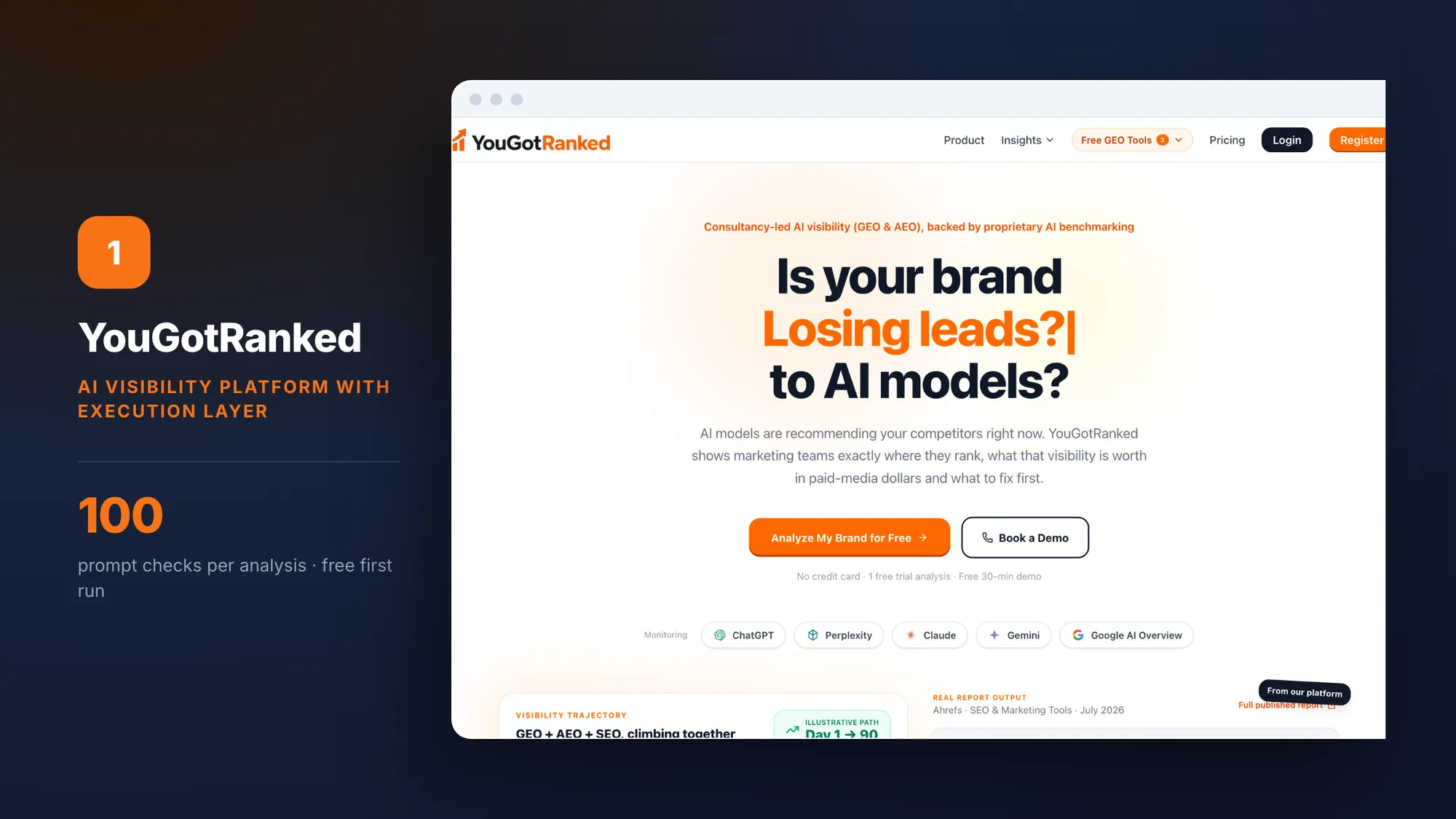
AI visibility platform with execution layer
Best for: marketing teams and agencies who have to act on AI visibility, not just report it
- Engines covered
- ChatGPT, Claude, Gemini, Perplexity, Google AI Overview
- Prompts on entry tier
- 100 prompt checks per analysis · 40 free
- Entry price
- Free · $79/mo Pro · $199/mo Growth
- Free path
- One full analysis, no card
What it does well. Every analysis runs real buyer-intent prompts across organic, brand, and competitive clusters — up to 100 prompt checks per scan — against all five answer surfaces, and samples each prompt multiple times rather than once. That repeated sampling is the point: a single query per prompt produces a score that moves several points a day on its own, and you cannot build a reporting line on it.
The reports resolve down to individual evidence. The citation engine lists every URL the engines cited, split by whether you own it, which engines used it, and what kind of source it is — media, forum, review site, competitor. Since this year it also reads the pages themselves to show who wrote them: the journalist or analyst behind each citation, the articles of theirs the engines used, and a link to their author page. For a PR or content team that changes the next action from "publish more" to "these four writers are shaping your category's answers".
Where a brand is missing, the keyword and topic gap analysis shows the exact prompts where a term appeared, who was named instead of you, and the passage the engine used — backed by real Google search demand and cost-per-click, so the gaps are ranked by buyer volume rather than by how interesting they look.
Each report ends in a letter grade, a free AI readiness audit verified against your live HTML (schema markup, AI-crawler access, structured data, FAQ markup), and a ranked action plan sequenced by how long each fix takes to ship. Paid plans add a monthly content plan generated from your own Search Console data, and Growth adds GA4 AI-referral tracking so you can see when an AI answer actually sent someone to your site.
Key features: multi-sampled scoring across five answer surfaces · citation ledger with owner, engine, and source-type breakdown · author attribution on cited pages (Growth and Custom) · keyword and topic gap analysis with real search demand and CPC · free AI readiness audit · ranked action plan · Search Console and GA4 integration · Earned Media Value modelling that converts visibility into paid-media-equivalent dollars · daily monitoring on retainer plans.
Who it is not for. Author attribution sits on Growth and above rather than the entry tiers. And the product is opinionated — it is built to hand you a prioritised plan, which is the wrong shape if what you want is a raw mention feed to pipe into your own warehouse and interpret with an in-house analytics team.
Pricing: Scout is free — one full analysis, 40 prompt checks, and the AI readiness audit, no card. Pro is $79/mo ($71/mo billed annually) for 5 analyses a month at 100 prompt checks each. Growth is $199/mo ($179/mo annually) for 15 analyses, unlimited competitors, GA4 AI-referral tracking, author attribution, and a monthly strategist call. Custom covers daily monitoring and strategist-led execution.
See where you stand before you shortlist anything
Run one full analysis free — scored separately on ChatGPT, Gemini, Perplexity, and Google AI Overview, with the citation ledger and a ranked action plan. No card.
Analyze My Brand for Free →
2. Profound — best for enterprise analytics depth
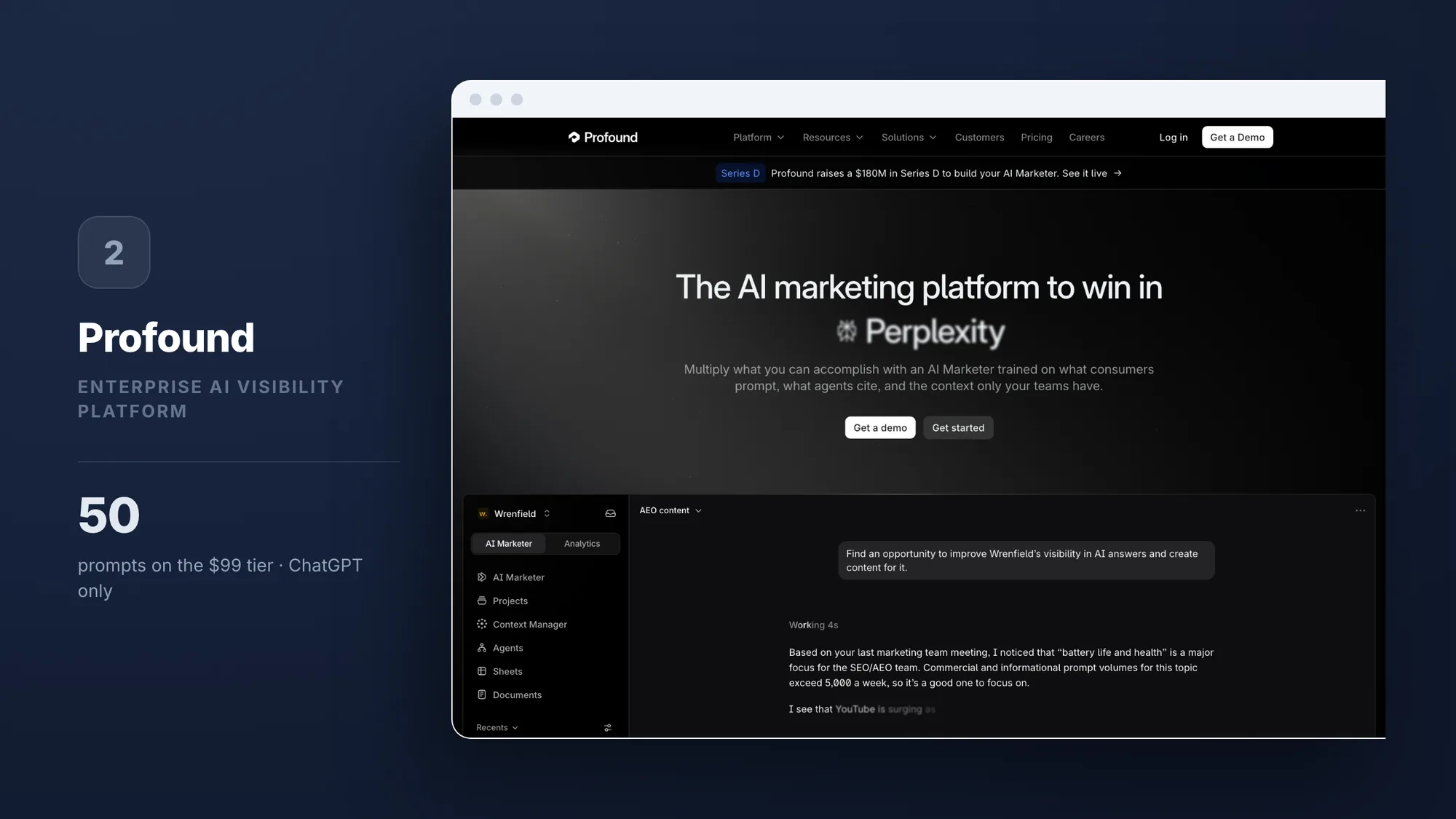
Enterprise AI visibility platform
Best for: large organisations with in-house strategists who want a deep, self-serve data warehouse of AI mentions
- Engines covered
- ChatGPT only on Starter · 3 engines on Growth
- Prompts on entry tier
- 50 on Starter · 100 on Growth
- Entry price
- $99/mo · $399/mo · Custom
- Free path
- Demo
What it does well. Profound is one of the most established platforms in the category and is usually the first name on an enterprise shortlist for good reason. It carries a very large prompt database, covers a wide set of engines, and gives analytics teams a genuinely deep surface to work across. If you have the people to interpret raw signal and turn it into a content and PR programme, the depth is an asset rather than a burden.
Key features: large prompt database · broad engine coverage on upper tiers · conversation and citation analytics · API access on Enterprise · seat-based team structure.
Watch-outs. The entry tier is narrower than the price suggests — $99/mo covers ChatGPT only, 50 prompts, and a single seat, so a realistic multi-engine deployment starts at the $399 Growth tier. And the recurring criticism in user write-ups is interpretation: it shows you a great deal and tells you comparatively little about what to do next. Budget for the strategist alongside the licence.
Pricing: Starter $99/mo billed yearly (ChatGPT only, 50 prompts, 1 seat). Growth $399/mo billed yearly (3 engines, 100 prompts, 3 seats). Enterprise custom, with full engine coverage and API access.
3. Peec AI — best clean daily tracker for a small team
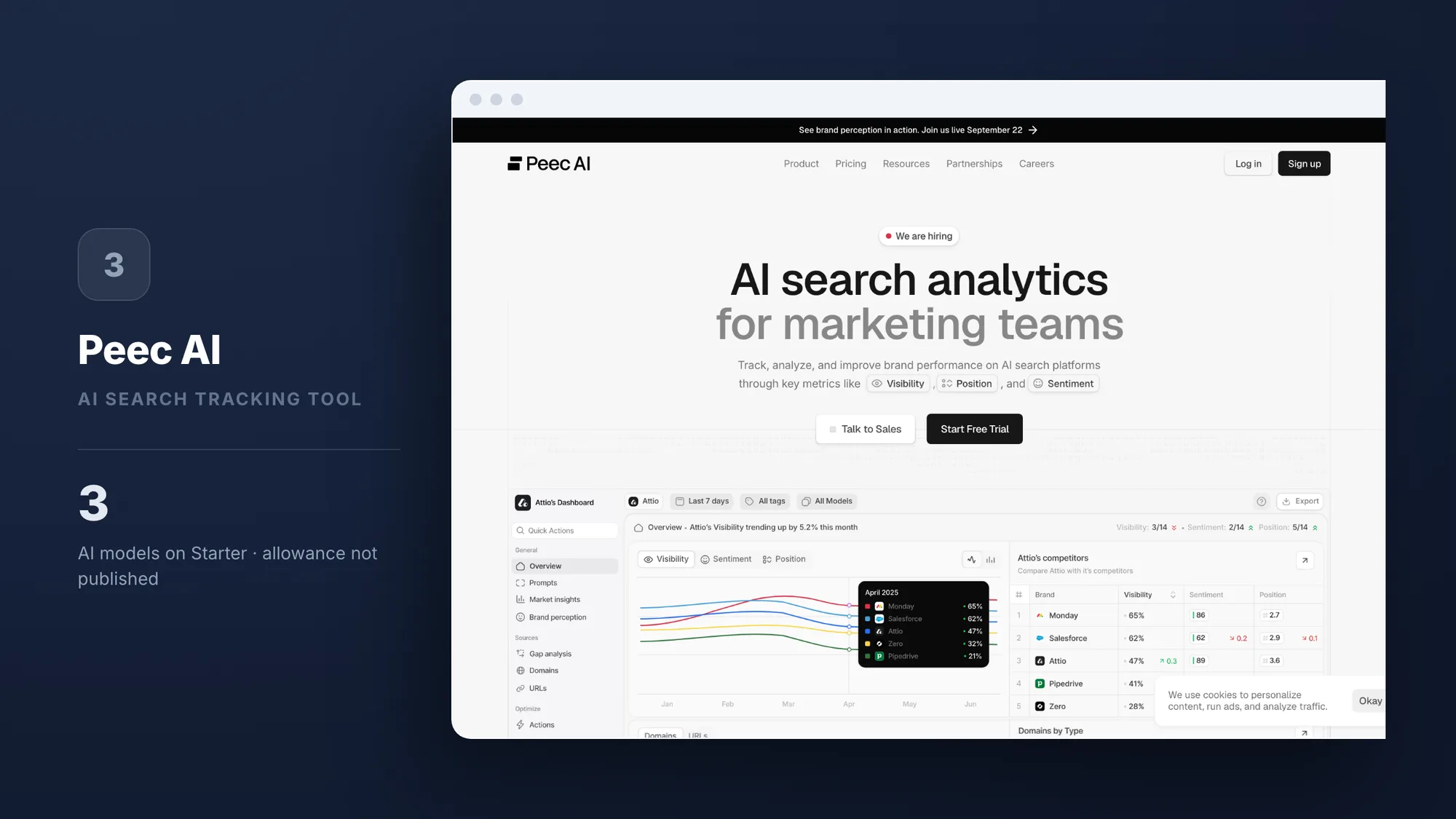
AI search tracking tool
Best for: small marketing teams who want an inexpensive, well-built daily tracker and will handle strategy themselves
- Engines covered
- 3 AI models on Starter
- Prompts on entry tier
- Not published
- Entry price
- From $95/mo
- Free path
- 7-day trial
What it does well. Peec deserves credit for accessibility. It is inexpensive relative to the enterprise tier, offers unlimited seats even on entry plans, updates daily, and ships workflow features that are genuinely useful day to day — sentiment, prompt tagging, and one-click gap analysis. The interface is clean and the learning curve is short, which matters when the tool has to be usable by a two-person team rather than an analytics function.
Key features: daily tracking · unlimited seats on entry plans · sentiment analysis · prompt tagging · gap analysis · competitor comparison.
Watch-outs. The Starter tier covers three AI models, so check whether the engines that matter in your market are among them. Neither the prompt allowance nor pricing above Starter is published, which makes budgeting past the first year harder. And like most trackers in this bracket, it reports what is happening without producing a prioritised plan or a content calendar off the back of it.
Pricing: Starter from $95/mo (3 AI models, daily tracking, unlimited seats), with a 7-day trial. Pro/Advanced on request. Enterprise custom.
4. Otterly.ai — best entry price for solo marketers
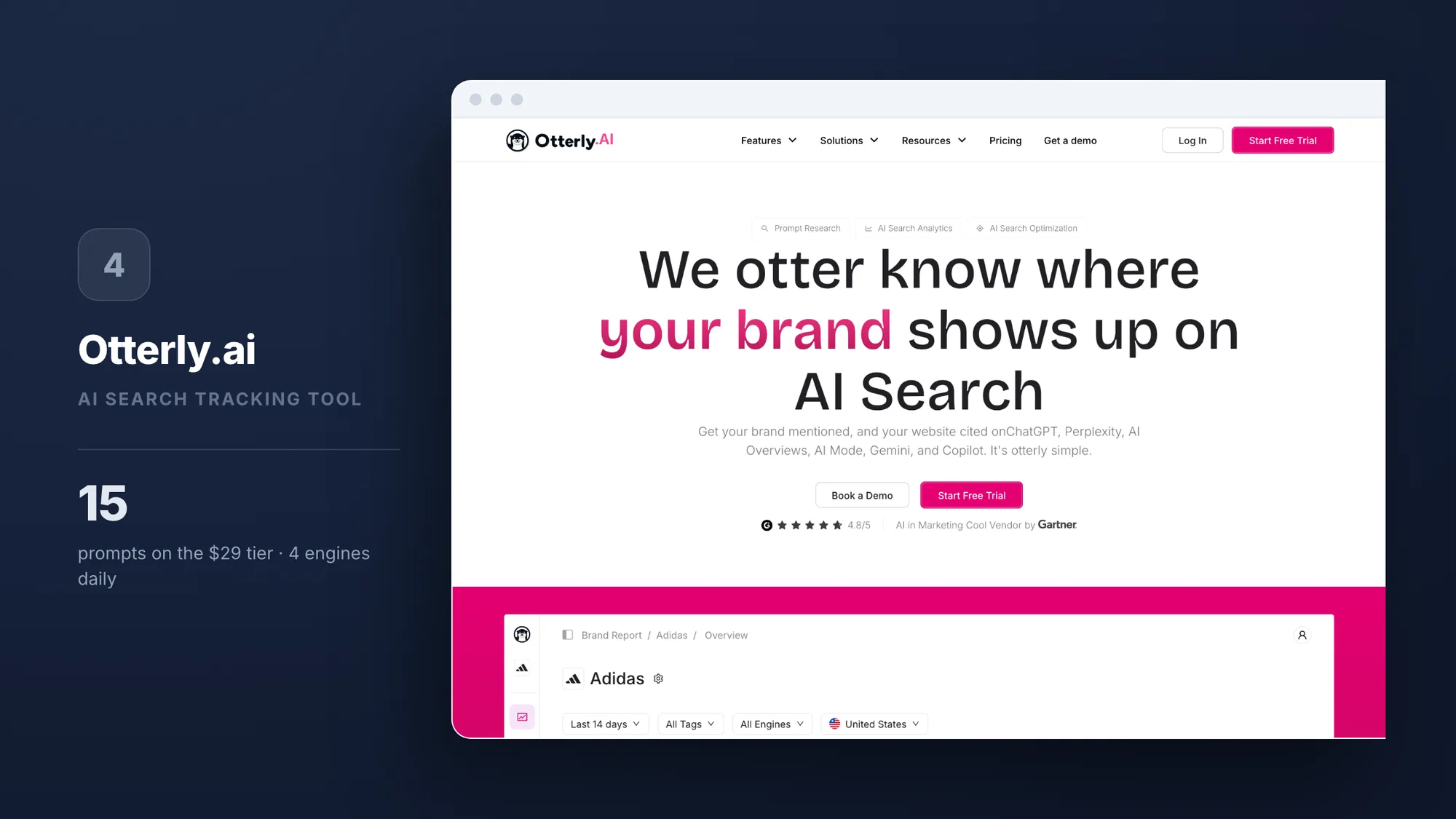
AI search tracking tool
Best for: solo marketers, consultants, and small agencies who need a cheap daily signal across a handful of prompts
- Engines covered
- ChatGPT, Google AI Overviews, Perplexity, Copilot
- Prompts on entry tier
- 15 on Lite · 100 on Standard · 400 on Premium
- Entry price
- $29/mo · $189/mo · $489/mo
- Free path
- Free trial on all tiers
What it does well. Otterly is the genuine low-cost entry to the category. It starts at $29 a month, tracks four engines daily, includes unlimited team members even on the entry plan, and adds GEO URL audits. For a consultant who needs to show a client whether they appear in AI answers at all, it does that job for less than the cost of a lunch.
Key features: four engines tracked daily · unlimited seats on every tier · GEO URL audits · link and mention tracking · free trial on all tiers.
Watch-outs. Fifteen prompts on the Lite tier is a sample, not a picture — enough to prove a problem exists, not enough to diagnose it. Realistic coverage sits at the $189 Standard tier (100 prompts), which puts it in the same bracket as tools that do considerably more. Citation depth and strategic output are both thin compared with the platforms above it.
Pricing: Lite $29/mo (15 prompts, 4 engines daily). Standard $189/mo (100 prompts). Premium $489/mo (400 prompts). All tiers include unlimited seats and a free trial.
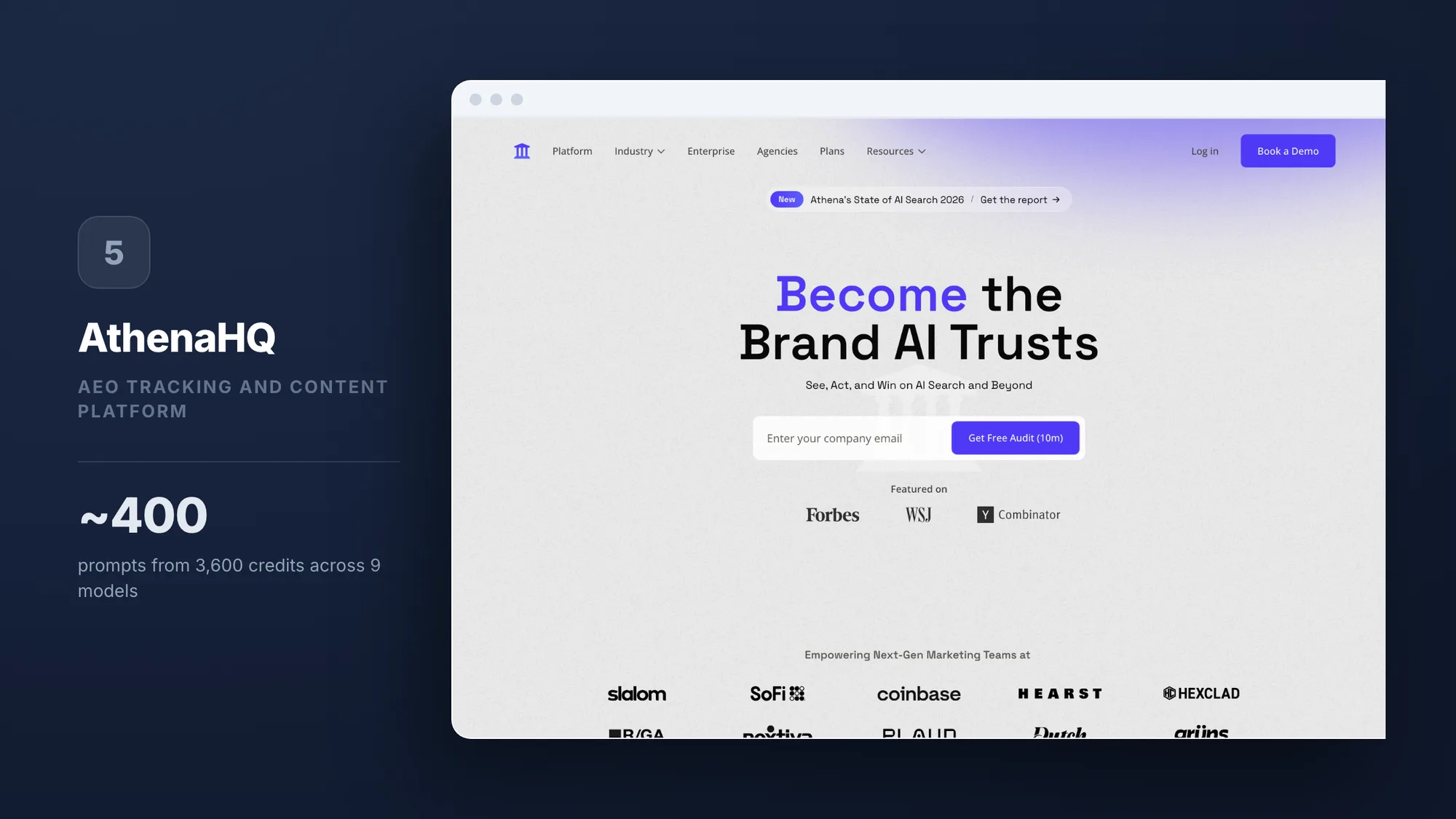
5. AthenaHQ — best all-in-one AEO content production
AEO tracking and content platform
Best for: teams who want tracking and content production in one place, with an unlimited-seat model
- Engines covered
- 9 models, credit-metered
- Prompts on entry tier
- 3,600 credits/mo · ~400 prompts in one location
- Entry price
- Free credit · $295/mo · Custom
- Free path
- $25 starting credit
What it does well. AthenaHQ is a genuine peer product rather than a thin tracker. It monitors the major assistants, ships content-production tooling alongside the analytics, markets an unlimited-seat model, and carries a strong G2 reputation. If your priority is a single self-serve platform where the team both sees the gaps and drafts the content that fills them, it is a credible pick.
Key features: tracking across nine models · content production tooling · unlimited seats · free tier with starting credit · location-level tracking.
Watch-outs. The credit model is the thing to model carefully: one credit is one prompt on one model in one location, so 3,600 credits a month across nine models and two locations is 200 prompts, not 3,600. Work out your real prompt count before comparing the $295 tier against a flat-rate competitor.
Pricing: Essential free with $25 starting credit. Starter $295/mo (3,600 credits across 9 models). Enterprise custom.
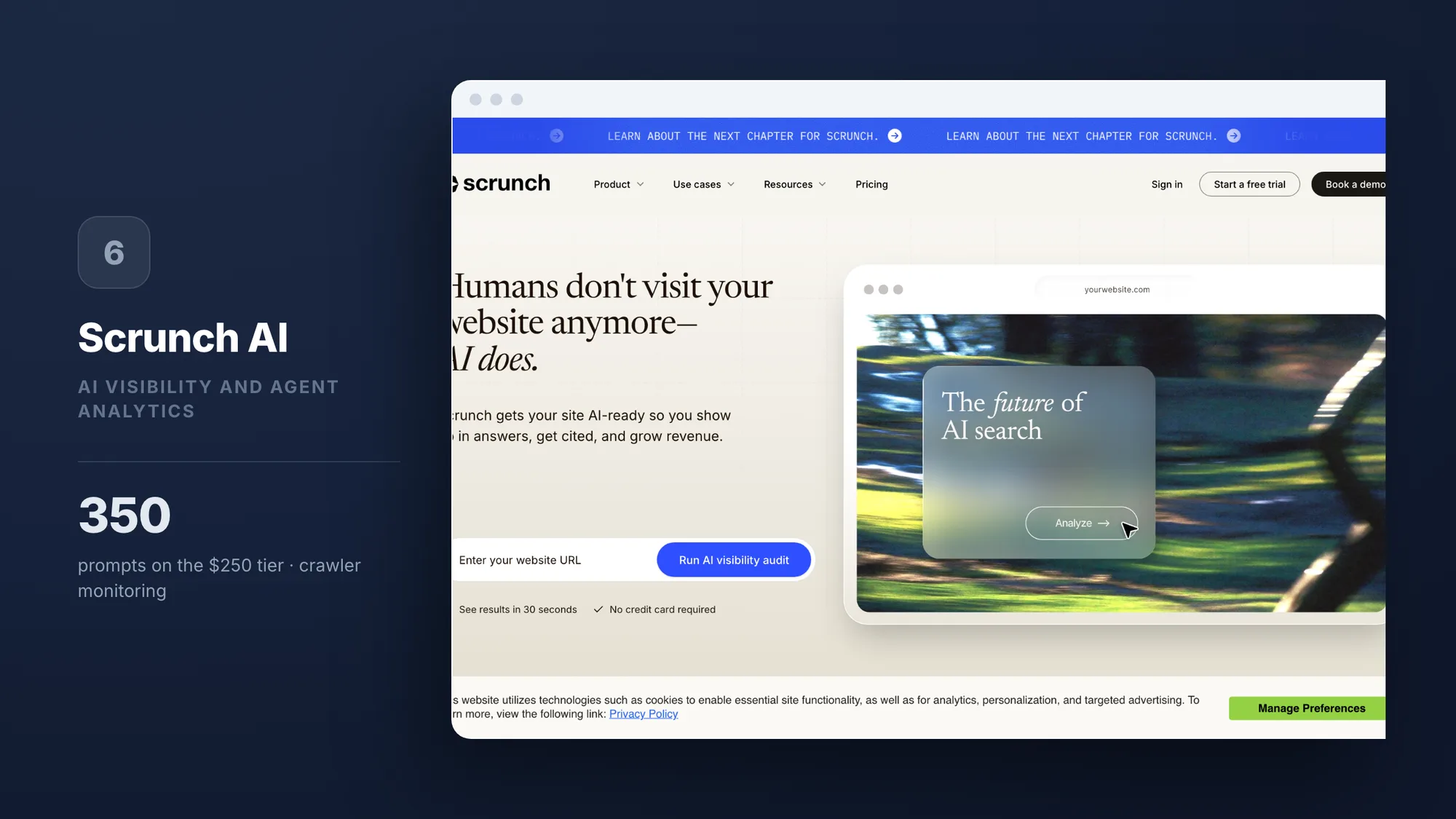
6. Scrunch AI — best for agent and crawler visibility
AI visibility and agent analytics platform
Best for: teams who care about how AI crawlers and agents interact with their site, not just what the assistants say
- Engines covered
- ChatGPT, Claude, Gemini, Perplexity, AI Overviews, Meta
- Prompts on entry tier
- 350 on Starter · 700 on Growth
- Entry price
- $250/mo annual ($300 monthly) · $417/mo · Custom
- Free path
- 7-day trial on Starter
What it does well. Scrunch is built specifically for AI search and agent ecosystems, and it shows. It monitors a broad set of surfaces, tracks citations and personas, and adds agent-traffic monitoring that watches how AI crawlers actually hit your site. That last piece is rare and increasingly relevant: if agents cannot fetch your pages, nothing else in your AEO programme matters.
Key features: wide surface coverage including Meta · citation tracking · persona-based prompt modelling · AI agent and crawler traffic monitoring · 350 prompts on the entry tier.
Watch-outs. The entry point is $250/mo on annual billing ($300 month-to-month), which rules it out for small teams, and everything above Starter is demo-led. The agent-analytics angle is a strong differentiator but only if crawler behaviour is a live problem for you — for many brands, absence from answers is a content and citation problem, not a crawl one.
Pricing: Starter $250/mo billed annually, $300 month-to-month (350 prompts, 3 seats), 7-day trial. Growth $417/mo annually, $500 month-to-month (700 prompts). Enterprise custom.
7. Semrush AI Visibility Toolkit — best if you already live in Semrush
AI module inside a traditional SEO suite
Best for: teams already paying for Semrush who want AI visibility in the same login as their keyword and backlink work
- Engines covered
- Major assistants, bundled into paid SEO tiers
- Prompts on entry tier
- 50 daily on Starter · 200 on Advanced
- Entry price
- ~$199/mo · ~$549/mo, on top of an SEO plan from $139/mo
- Free path
- Trial via Semrush
What it does well. Semrush is a category-defining SEO platform, and nothing here argues against using it for what it was built for — keyword research, rank tracking, backlink analysis, site audits, and competitive intelligence are deep and mature. The Keyword Gap tool in particular remains one of the better ways to compare coverage against competitors in traditional search. The AI Visibility Toolkit extends that into prompt tracking without adding a vendor or a second reporting stack.
Key features: prompt tracking bundled into the SEO suite · shared data with keyword and backlink tooling · one login and one invoice · familiar reporting surface for existing users.
Watch-outs. It is not sold standalone — the toolkit is bundled into paid SEO tiers, so the true cost is the SEO plan plus the AI add-on. Prompt ceilings are modest for the combined price, and the AI features sit alongside a product whose core assumptions are still about ranked pages rather than generated answers. Citation-level and author-level evidence are not its strength.
Pricing: SEO plans from $139/mo (no AI visibility). AI Visibility Starter ~$199/mo (50 prompts tracked daily). AI Visibility Advanced ~$549/mo (200 prompts daily).
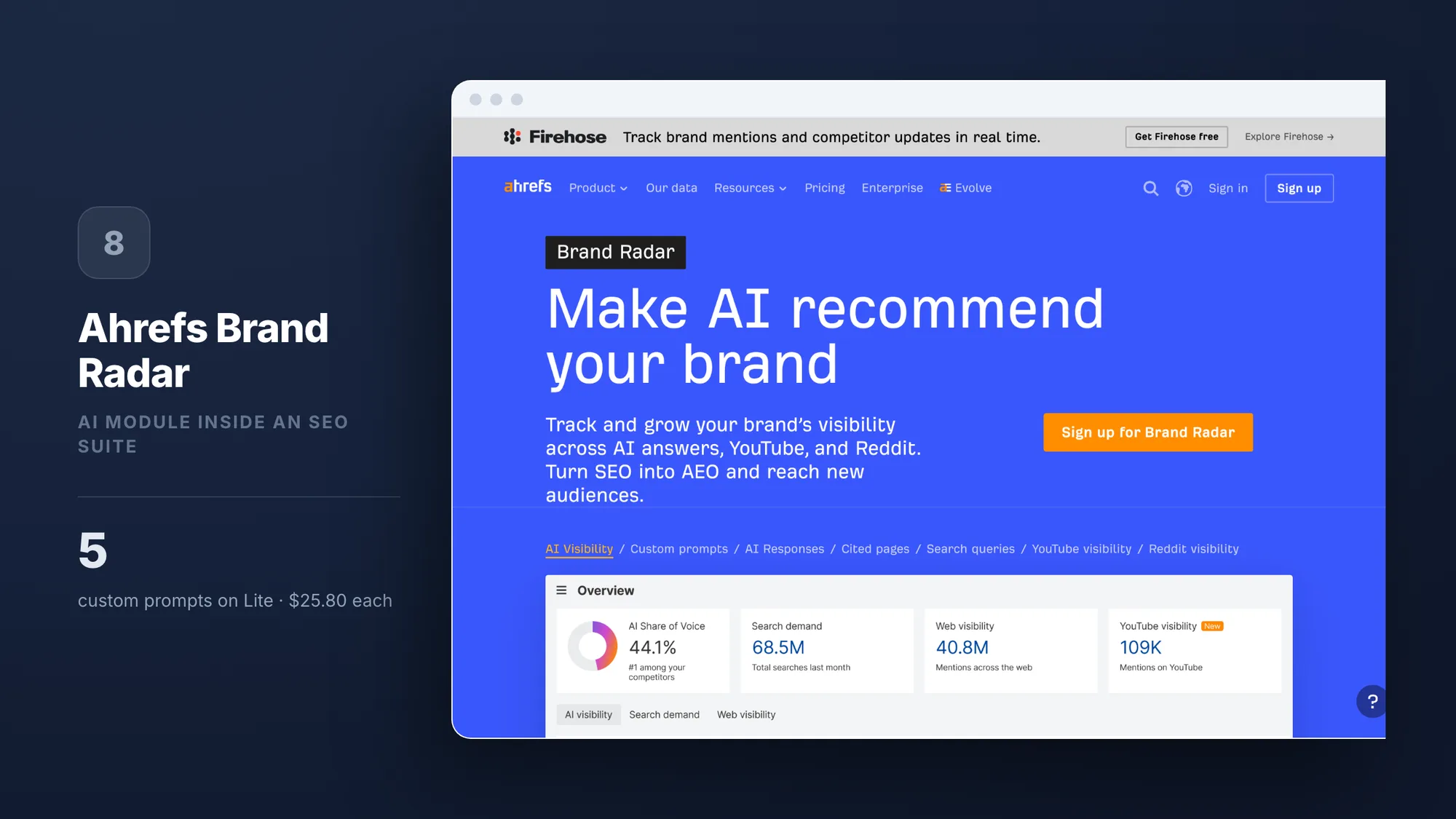
8. Ahrefs Brand Radar — best for macro prompt research
AI module inside a traditional SEO suite
Best for: SEO teams who want big-picture prompt research attached to the link index they already trust
- Engines covered
- Prompt and response database across major assistants
- Prompts on entry tier
- 5 on Lite · 10 on Standard · 20 on Advanced
- Entry price
- $129/mo · $249/mo · $449/mo
- Free path
- Limited — add-on for heavier tracking
What it does well. Ahrefs is outstanding at what it was built for: backlink analysis, keyword research, rank tracking, and site audits, backed by one of the largest link indexes in the industry. Its Content Gap tool is a well-regarded way to find terms competitors rank for and you do not. Brand Radar extends that with a very large database of AI prompts and responses, which makes it genuinely useful for macro-level research — understanding how a category is being asked about, rather than tracking your own handful of questions.
Key features: very large AI prompt and response database · tight integration with Ahrefs' link and keyword data · brand mention trends across engines · strong underlying data assets.
Watch-outs. Custom prompt tracking is the weak point: 5 prompts on Lite, 10 on Standard, 20 on Advanced, with heavier tracking as a paid add-on. At $129 for five prompts that is $25.80 per tracked prompt per month, the highest figure in this comparison by a wide margin. It is a research instrument, not a monitoring one.
Pricing: Lite $129/mo (5 prompts). Standard $249/mo (10 prompts). Advanced $449/mo (20 prompts). Additional prompt tracking is a paid add-on.
9. Conductor — best for enterprise content organisations
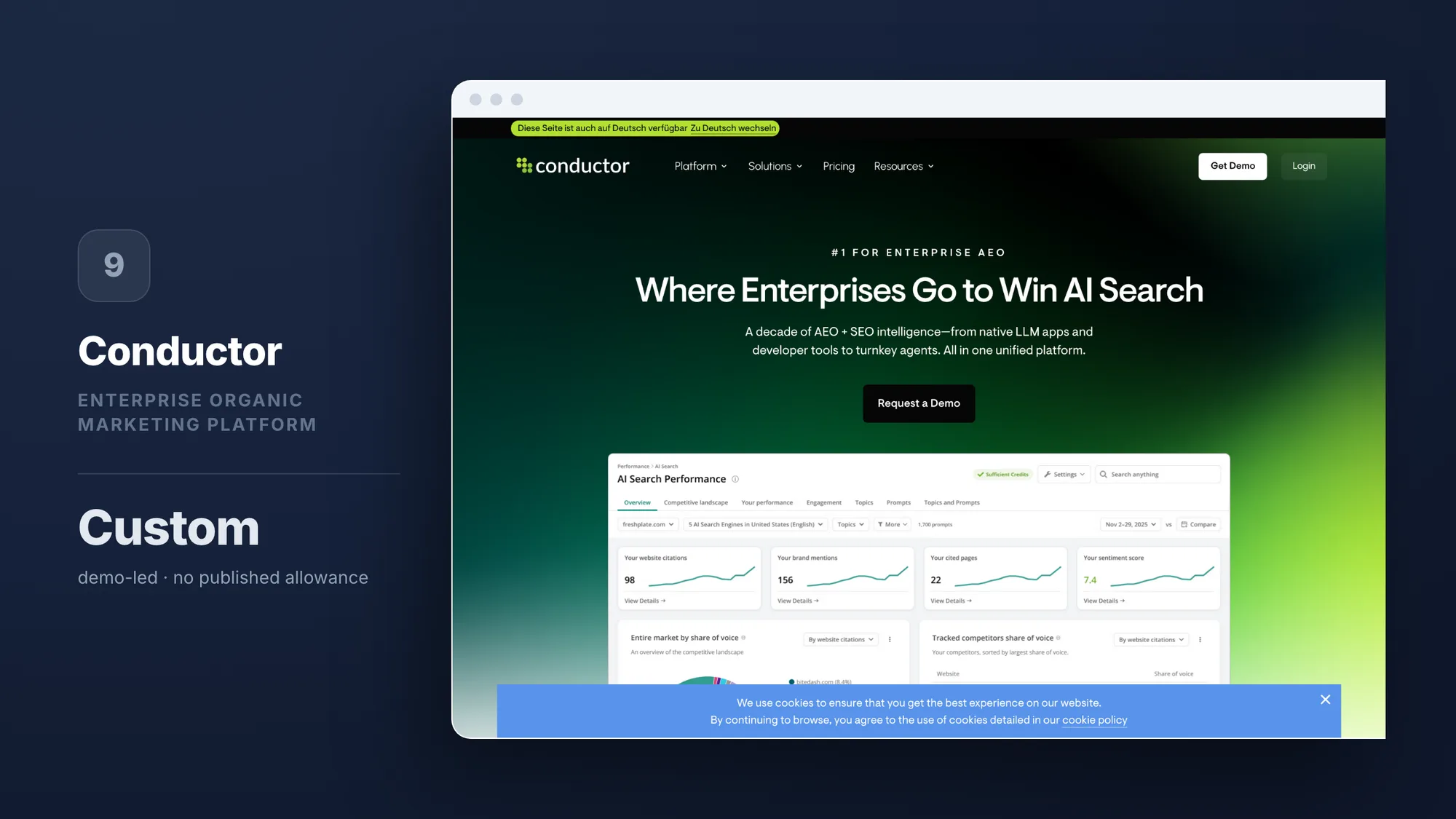
Enterprise organic marketing platform
Best for: large organisations that want one broad platform for content and organic marketing, with AEO folded in
- Engines covered
- Across Intelligence, Creator, and AgentStack products
- Prompts on entry tier
- Not published
- Entry price
- Custom, usage-based
- Free path
- Demo only
What it does well. Conductor is a serious enterprise platform for organic marketing and content, with mature workflow tooling, content guidance, and a growing set of AEO features across its Intelligence, Creator, and AgentStack products. For an organisation with distributed content teams that needs governance, permissions, and workflow as much as it needs measurement, a broad platform is often the right answer even when a focused tool measures better.
Key features: enterprise content workflow and governance · content guidance tooling · expanding AEO feature set · established enterprise support model.
Watch-outs. No self-serve entry and no published pricing — everything runs through a demo and an annual contract. The AI visibility capability is one module inside a wide platform rather than the centre of the product, so depth on citation and prompt-level evidence tends to lag the AI-native tools.
Pricing: Essentials, Growth, and Enterprise tiers, all usage-based and sales-led.
10. BrightEdge — best for enterprises already standardised on it
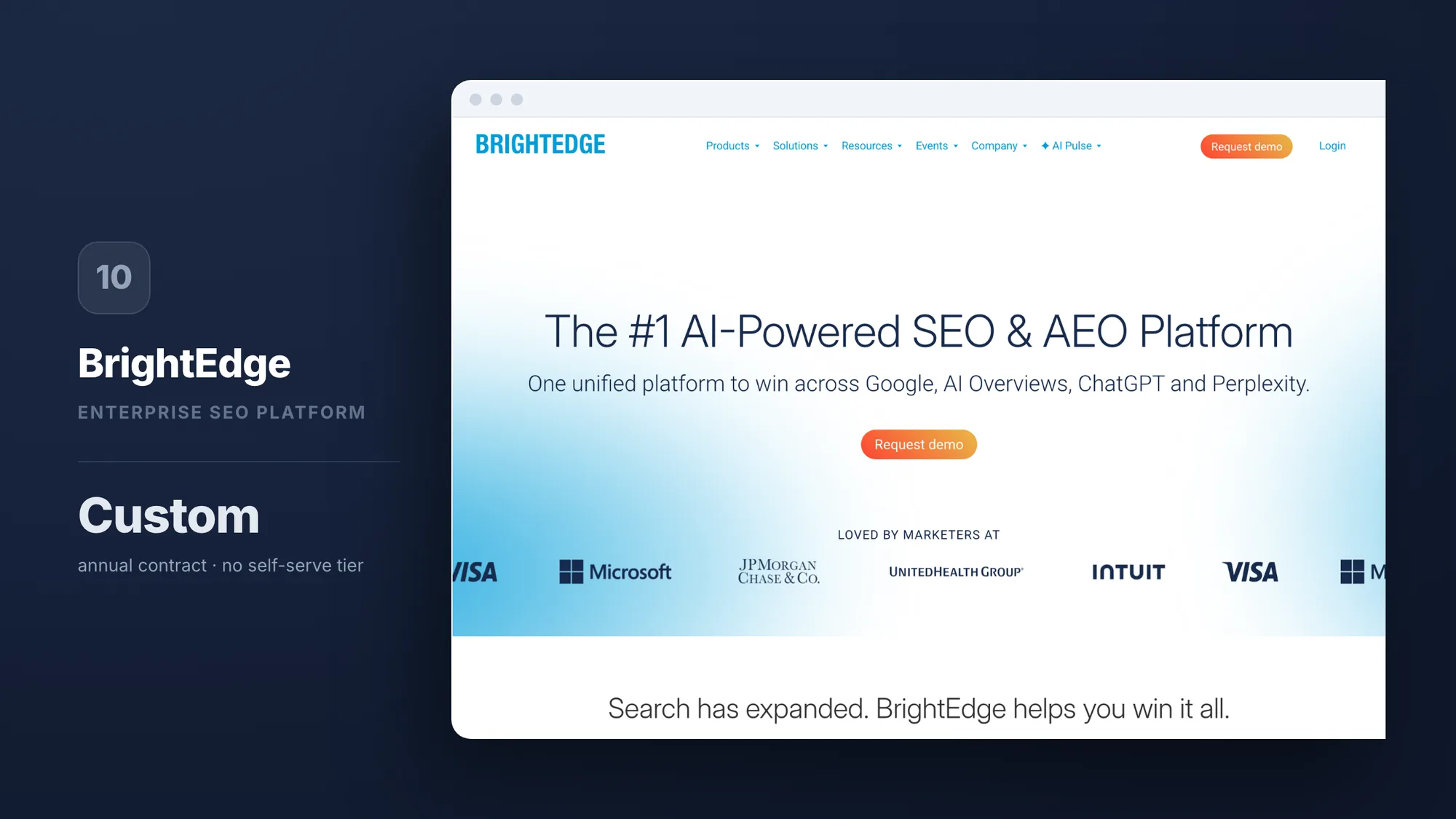
Enterprise SEO platform
Best for: large enterprises already running SEO at scale on BrightEdge who want AI features from the incumbent
- Engines covered
- AI Catalyst and Copilot across major surfaces
- Prompts on entry tier
- Not published
- Entry price
- Custom, annual contract
- Free path
- Demo only
What it does well. BrightEdge is an established enterprise platform with deep data assets, including Data Cube keyword research, and it has added AI features — AI Catalyst and Copilot — aimed squarely at the shift to AI search. If your organisation already reports on BrightEdge, extending the existing contract avoids a procurement cycle and keeps one reporting language across the team.
Key features: Data Cube research dataset · AI Catalyst and Copilot · enterprise-grade reporting and support · long track record at scale.
Watch-outs. Demo-only, annual contract, no free tier or self-serve path. The platform's core metrics — share of voice and blended rank chief among them — were designed for a results page where organic listings sat at the top, and they cannot see whether you are named inside an answer. The AI features are an extension of an SEO platform rather than a purpose-built answer-layer product.
Pricing: Enterprise, custom, annual contract.
How to choose between them
Three questions settle most shortlists. Do you need a measurement or a programme? How many questions does your category actually generate? And can you see the sources behind an answer you lost? Ask every vendor in a demo to show you the individual pages behind one answer where a competitor won and you did not, and who wrote them. That single request predicts how useful the tool will be in month three better than any feature list.
If
You are a solo consultant proving a client has a problem
Start with
Otterly.ai
$29 a month and four engines tracked daily is the cheapest credible evidence you can put in front of someone.
If
You have an analytics team and want raw signal to model yourself
Start with
Profound
The deepest self-serve data surface in the category, provided you budget for the strategist who interprets it.
If
AI crawlers may not be reaching your site at all
Start with
Scrunch AI
Agent and crawler traffic monitoring is rare, and a crawl problem makes every other AEO fix pointless.
If
You need to know what to publish next, not just where you stand
Start with
YouGotRanked
Citation and author evidence, gap analysis weighted by real search demand, and a ranked action plan — free to run once.
FAQ
What is an AI visibility tool? A platform that sends a set of buyer questions to AI assistants — ChatGPT, Gemini, Perplexity, Claude, Google's AI Overview — on a schedule, and reports whether your brand is named in the answers, in what tone and position, and which sources the engines cited. It is the closest available equivalent to rank tracking for the answer layer.
What is the best AI visibility tool in 2026? It depends on whether you need data or direction. Profound leads on enterprise analytics depth, Otterly.ai on entry price, Scrunch on agent and crawler visibility, and YouGotRanked on turning the measurement into a prioritised plan with citation- and author-level evidence. The free first analysis is the fastest way to see which of those problems you actually have.
How much do AI visibility platforms cost? Published entry prices in September 2026 run from $29/mo (Otterly Lite, 15 prompts) to $295/mo (AthenaHQ Starter), with realistic multi-engine deployments typically landing between $200 and $500 a month. Conductor and BrightEdge are demo-only with custom annual contracts. YouGotRanked starts free and is $79/mo on Pro.
Which AI visibility tool gives the most prompts for the money? On published entry tiers, Scrunch AI is cheapest per tracked prompt at roughly $0.71 ($250 for 350 prompts), followed by AthenaHQ at about $0.74 and YouGotRanked at $0.79. The most expensive is Ahrefs Brand Radar at $25.80 per prompt ($129 for 5). Tracking cadence differs between vendors, so treat this as coverage per dollar rather than a like-for-like rate.
Is there a free AI visibility tool? There are free entry points rather than free platforms. YouGotRanked runs one full analysis free with no card, AthenaHQ gives $25 of starting credit, and Peec, Otterly, and Scrunch offer trials. Free tiers are enough to establish whether you have a visibility problem; diagnosing it takes a larger prompt set.
How is AI visibility tracking different from SEO rank tracking? Rankings are public and stable; AI answers are generated per conversation and vary between runs, so every figure is a sample rather than an observation. The unit of measurement is a question rather than a keyword, most cited sources are pages you do not own, and the outcome is being named inside the answer rather than earning a click.
How many prompts do I need to track? Enough to represent how your category is actually asked about — for most B2B and healthcare categories that is well into the hundreds, not dozens. A small prompt set does not just give you less data; it gives you a score that reflects your prompt selection more than your visibility.
Do these tools show which pages the AI cited? The better ones do, at varying depth. A domain list is the baseline; individual URLs with the engines that used them is more useful; and resolving those pages to the journalists and analysts who wrote them is the newest layer, currently rare across the category. Ask for it specifically in demos.
Can I just use Semrush or Ahrefs for this? If you already pay for them and want a directional signal, yes. Both have added AI visibility modules with real underlying data. The constraint is prompt volume — 5 to 20 custom prompts on Ahrefs tiers, 50 to 200 on Semrush's AI toolkit — and comparatively shallow citation evidence. They are good complements to an AI-native tool and thin substitutes for one.
Go deeper: What Is Answer Engine Optimization? · What Is AI Search Visibility? · There Is No Search Console for AI Prompts · Signals That Make Content Citable · Compare YouGotRanked vs Profound