On August 2, 2026, the transparency rules of the EU AI Act came into force. Nine days later, Anthropic announced that every Claude model would embed an invisible, machine-readable watermark in the text it produces. Not just for European users. Globally, with no opt-out. Google's SynthID, which does the same job for Gemini, Imagen, Veo, and Lyria, had already marked over 10 billion pieces of content by then. OpenAI has joined the same provenance coalition, and Meta is rolling Content Credentials across Instagram.
Within a week, every marketing Slack we sit in had a version of the same thread. Is this the end of AI content? Will Google demote anything with a watermark? Do we need to stop?
The short answer is no.
The longer answer is that the panic gets the mechanism backwards. Watermarks say nothing about quality. Search engines have never ranked on authorship. And the companies deploying these watermarks are the same companies whose models write the content and whose engines rank it. Nobody builds a weapon aimed at themselves.
There is a real risk buried in this story, and it deserves your attention. It just has nothing to do with hidden fingerprints in your text. Let's go through what actually shipped, what the ranking data shows, and where the real work is.
If you only read one box
- The marks are compliance plumbing. EU AI Act Article 50 requires them. No search or AI company has tied them to rankings.
- They prove processing, not authorship. A grammar pass on your own writing can carry the same mark as a fully generated page.
- AI content already ranks. A 600,000-page study found a 0.011 correlation between AI share and position. That is zero.
- The bar that matters is citeability. Fresh, original, attributable content gets quoted by AI answers. Everything else gets ignored, human or not.
Terms in this piece
New to the acronyms? Each term below links to our field guide with plain-English definitions and how YouGotRanked scores them.
What actually shipped in August 2026
Strip away the headlines and three concrete things happened.
Anthropic began watermarking all Claude text output. The watermark subtly biases word choices in ways that become statistically detectable over enough text, while staying imperceptible to a reader. It survives copy-paste and light editing. Anthropic's own framing is precise and worth taking literally: the mark indicates text was "processed by" Claude, not authored by it. Run a paragraph you wrote yourself through Claude for a grammar pass and the output can carry the mark. Heavily edit a Claude draft, translate it, or quote a short excerpt, and the mark may not survive at all.
The second thing: this is regulatory compliance. Article 50 of the EU AI Act requires generative AI providers to mark outputs in machine-readable form, with fines reaching €15 million or 3% of global turnover. Anthropic chose to comply globally rather than run two separate infrastructures, which goes further than the law demands. Google went down this road years earlier with SynthID and has since open-sourced its text watermarking method so any developer can adopt it.
Third, provenance is becoming an industry standard rather than a policy of any one company. The C2PA coalition now includes Google, OpenAI, Adobe, Microsoft, Meta, Nvidia, and ElevenLabs, all converging on shared content credentials. This is plumbing for a world where knowing how content was made is possible. Whether that content deserves to rank is a separate question the plumbing cannot answer.
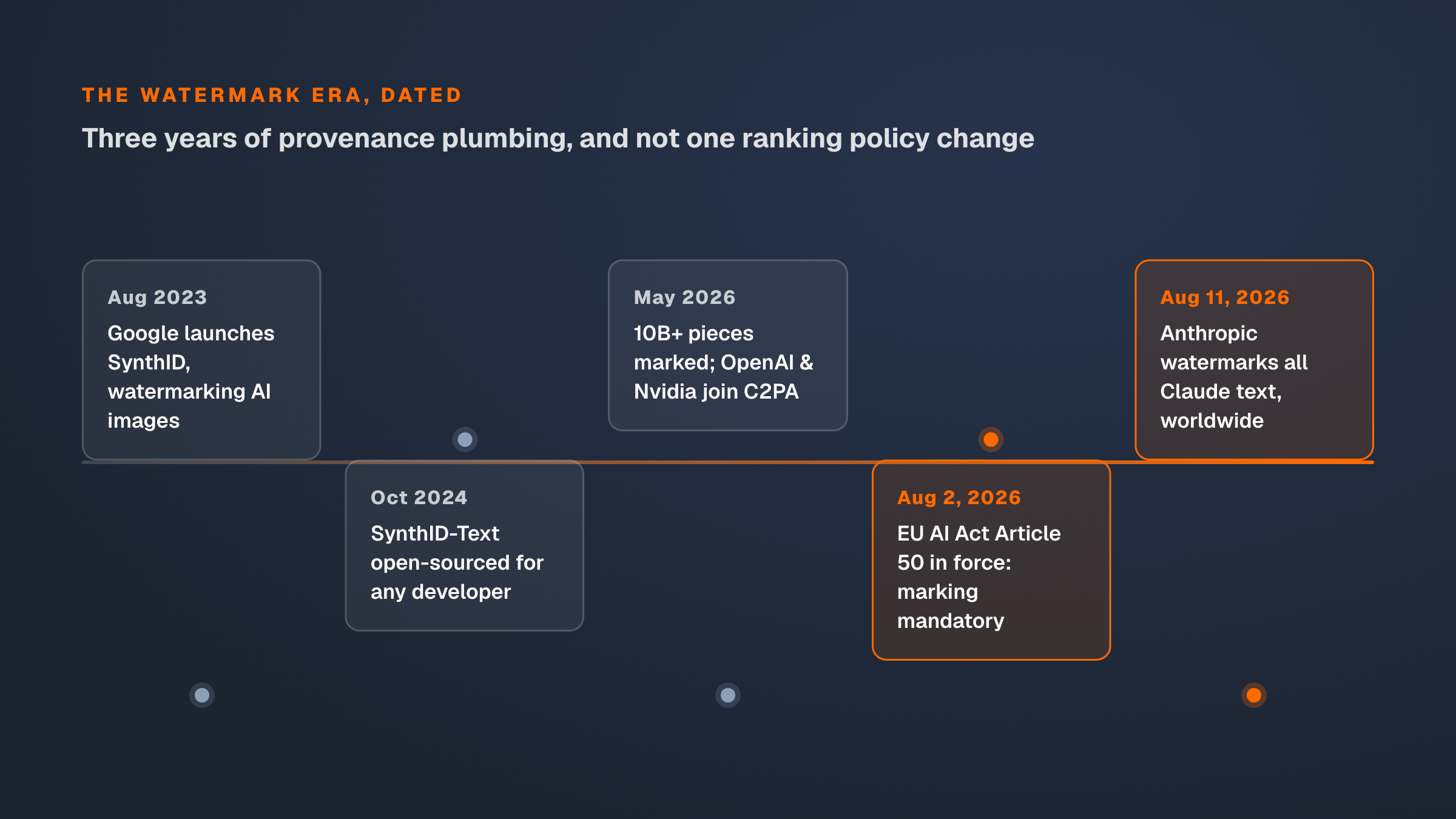
Notice what is missing from all of this: a single statement, from any search or AI company, that watermarked content will rank differently. That silence is not an oversight. It follows from how the technology works and from who builds it, so it helps to understand the mechanics first.
How text watermarking actually works
Image watermarks are old technology. Text watermarks are the new part, and they work nothing like a logo stamped on a photo. Two different systems are in play here, and conflating them fuels a lot of bad takes.
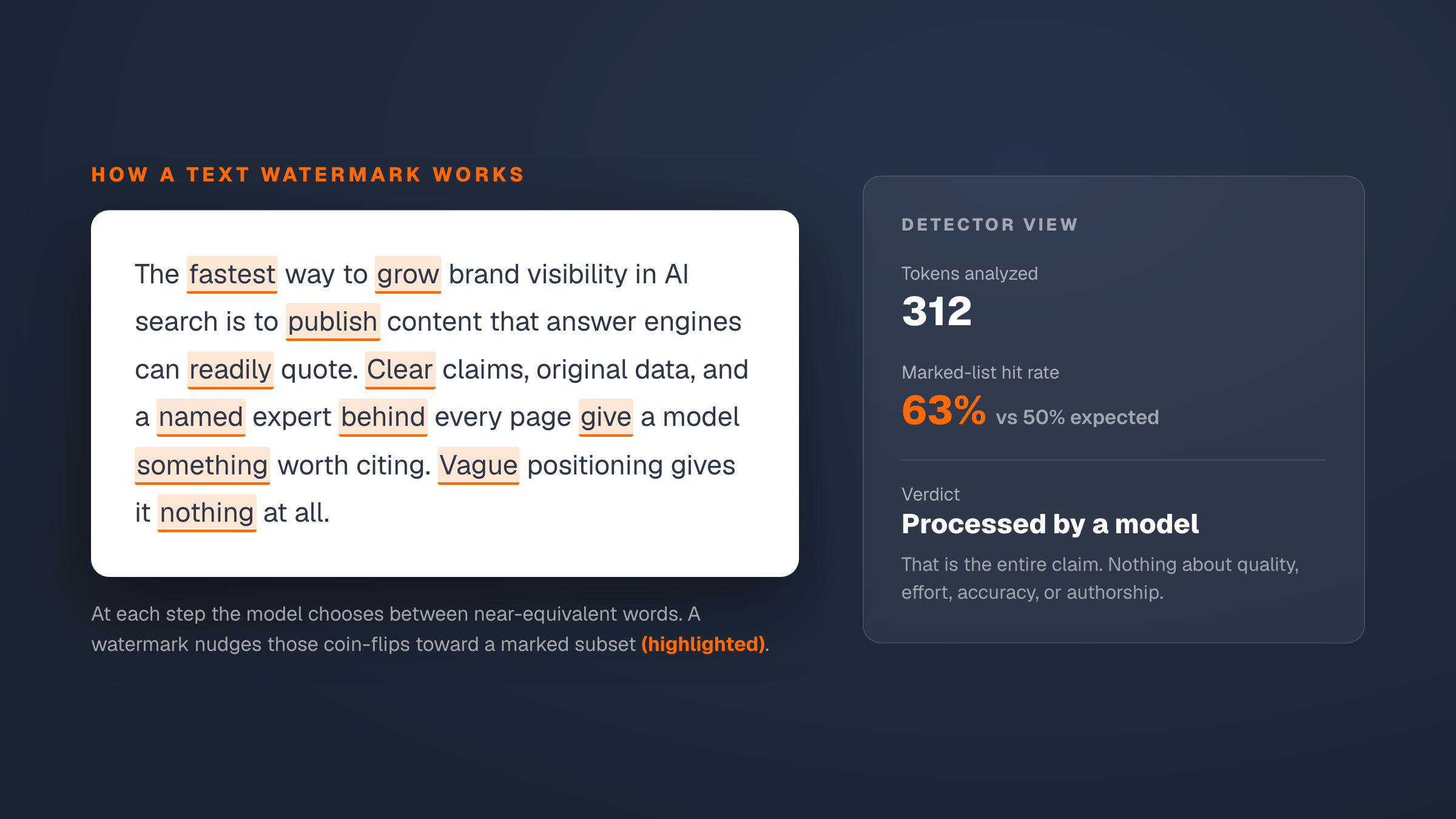
Statistical watermarks, the kind Claude and SynthID-Text use, operate at the moment of generation. Every time a model picks the next word, several candidates are nearly interchangeable: quick or rapid, shows or demonstrates, a comma or a period. A watermarking scheme uses a pseudorandom function to nudge those coin-flip choices toward a marked subset. No single word proves anything. Across a few hundred words, the skew becomes unmistakable to a detector holding the key, while a human reader sees ordinary prose. This is why the mark survives copy-paste (the words themselves carry it) and why it degrades under heavy rewriting or translation, where enough choices get re-rolled by a person or a different model. Very short text can't be reliably marked at all. There aren't enough coin flips to skew.
Rather than describe the mechanism, here it is. Move the paragraph below through the four stages, then apply a heavy human edit and watch the signal dissolve:
Interactive · Watermark detector simulator
Slide the same paragraph through the AI-processing spectrum and watch the detector respond.
Your bullet points, expanded and tightened by a model.
Model-chosen words
14 of 42
Marked-list hit rate
60% vs 50% chance
Verdict
Watermark detected
Enough choices came from the model for the skew to be unambiguous.
Illustrative simulation of green-list token bias, the mechanism behind SynthID-Text and Claude's watermark. Real detectors read thousands of choice points, and thresholds vary by provider. Notice what the verdict never says: whether the page is any good.
Provenance metadata, the C2PA and Content Credentials system, is a different animal: a cryptographically signed manifest attached to a file, recording how it was made and edited. It carries richer information, including which tool and what edits. It is also more fragile. Strip the metadata, screenshot the image, paste the text into a new document, and the manifest is gone. The industry runs both systems together for exactly this reason. Metadata where it survives, statistical marks where it doesn't.
Now look at what either system can actually assert about a page: some or all of this text passed through a model at some point. That's the whole claim. It says nothing about how much of the page, whether the ideas came from the model or from the expert prompting it, whether the data is original, or whether the advice is any good. A detector fires identically on a rigorous investigation that used Claude to tighten its prose and on the ten-thousandth interchangeable listicle. The watermark lives in the word-choice layer. Quality doesn't.
Search engineers understand this asymmetry, which is why watermark detection is useful for transparency purposes like labeling and deepfake response, and nearly useless as a ranking input. Ranking systems need signals that separate good pages from bad ones. As we're about to see, a signal that fires on three quarters of the new web separates nothing.
AI content already ranks. The data is unambiguous.
The fear underneath the watermark panic is really a fear about AI content in general: if they can detect it, they'll bury it. The problem with that theory is that AI content has been detectable at scale for years, and it ranks anyway.
The largest public study here is Ahrefs' analysis of 600,000 ranking pages, which measured the relationship between how much of a page is AI-generated and where it ranks. The correlation came out at 0.011. In practical terms, that is zero. Across a sample bigger than most cities, Google's ranking systems are indifferent to how the words were produced.
The same research shows how much AI content is already winning:
AI presence in top-ranking Google results
86.5% of top-ranking pages contain at least some AI-generated text. Even fully AI-generated pages hold top-3 positions, and they appear at every position on page one, including #1.
Source: Independent studies of 600k and 331k ranking pages, 2025–2026
Zoom out from rankings to the web itself and the picture gets more decisive. a longitudinal study of new web articles found that primarily AI-generated articles crossed 50% of new English-language articles in late 2025. The stream of new content is now about half machine-drafted, and in the search results the two halves are functionally indistinguishable. The same team's page-level analysis adds a detail that matters even more: only 2.5% of new pages are purely AI, and only 25.8% are purely human. The remaining 71.7% is a blend.
The composition of newly published web pages
Source: Independent 900k-page composition study, April 2025
That middle number deserves a moment. If detection meant demotion, Google would be demoting nearly three quarters of everything new on the internet, including most of the pages it currently ranks first. Search would simply stop working.
AI systems themselves are even less picky. Answer engines like ChatGPT, Perplexity, and Google's AI Overviews retrieve whatever best answers the query. an industry analysis of 680 million AI citations shows citation behavior driven by relevance, freshness, and authority. There is no authorship forensics step. AI already cites AI, constantly, and has no objection to its own species.
Where we stand, as a company that measures this
We build software that tracks how brands show up in AI answers, so we watch this from an unusual seat. We see which content ChatGPT, Gemini, Claude, and AI Overviews actually recommend, every day. Our founder Shahbaz Alam puts our position bluntly:
"If the content you're creating with AI is intentful, genuinely useful to a lot of people, the kind of thing others would cite, then a watermark changes nothing for you. That was true before August 2 and it's true after. AI systems already rank and cite AI-made content every day. And honestly, at this point almost 100% of what gets published has been AI-processed somewhere along the way. Proofreading, ideation, rephrasing, tightening a draft into a final. By that standard the entire internet is 'AI content.' So the watermark was never built to punish anyone. Ask yourself why the companies at the forefront of AI, the ones with their hands on the steering wheel, would turn the machinery against the very thing they're driving."
— Shahbaz Alam, founder, YouGotRanked
That's the whole argument in a few sentences. The rest of this piece is the evidence for each of them. It also matches what our own published research keeps finding: when we ran a full AI-visibility teardown of one of the most authoritative brands in SEO software, the gap that mattered had nothing to do with how its content was produced. It was whether the content earned citations.
Nearly everything online is AI-processed now
Here is a thought experiment that dissolves most of the panic. Which of these produces "AI-generated content"?
- Autocorrect fixing your spelling as you type
- Grammarly rewriting a sentence for clarity
- Google Docs suggesting the rest of your sentence
- Translating your post from Hindi to English with DeepL
- Asking ChatGPT to outline a piece you then write yourself
- Asking Claude to tighten a draft you wrote
- Pasting bullet points and asking a model to expand them
- Publishing a model's output untouched
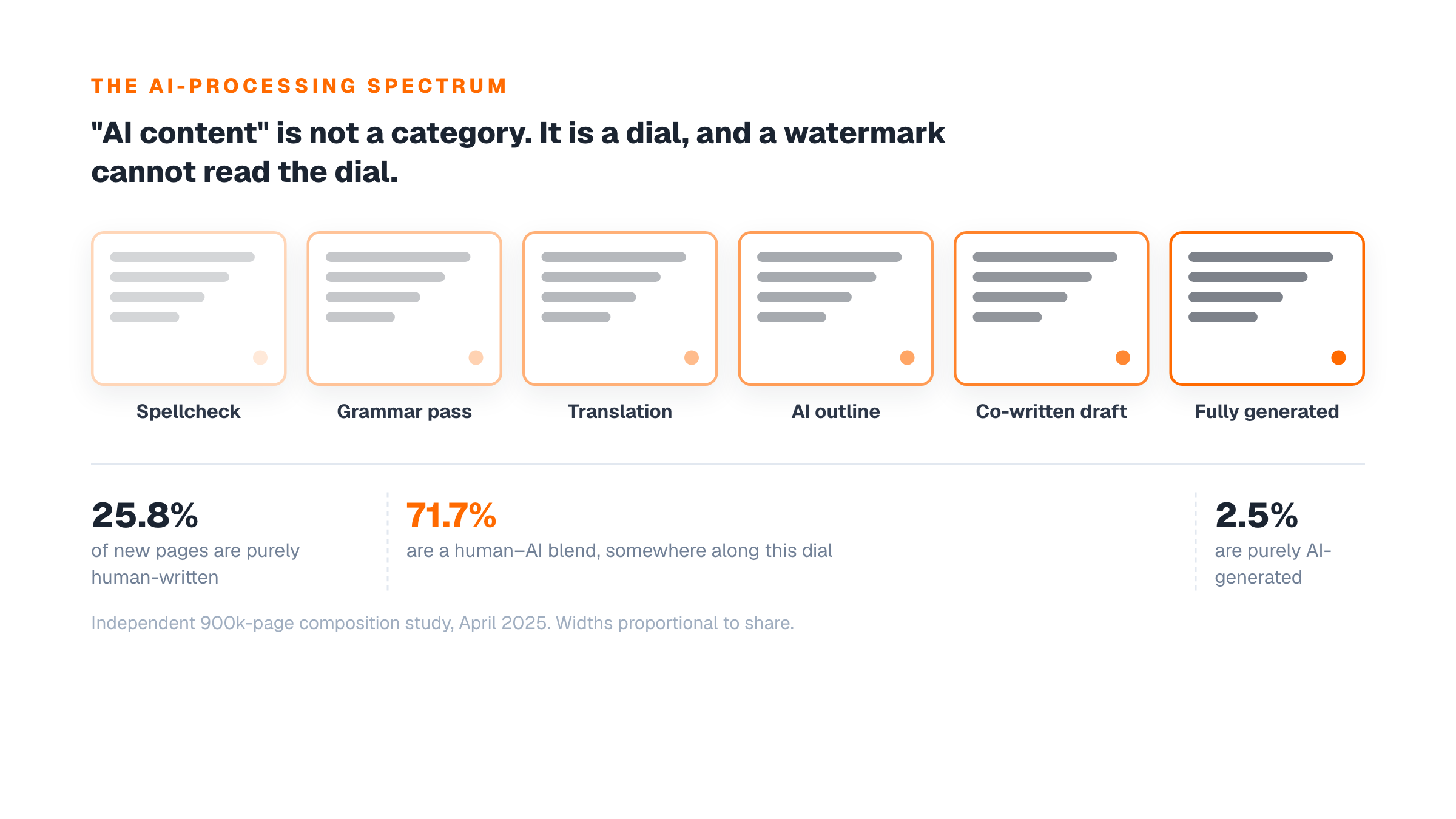
Everyone draws the "that's cheating" line at a different point on that list, and that disagreement is exactly why AI involvement makes no sense as a ranking signal. It isn't a category. It's a spectrum, and virtually all modern writing sits somewhere on it. Spellcheck is a language model. Autocomplete is a language model. Translation is a language model. If anything, the measured figure of 74.2% undercounts AI involvement, because light-touch processing frequently escapes detection altogether.
A watermark collapses this entire spectrum into one bit: a model touched this text. It cannot tell a meticulously researched, expert-reviewed analysis drafted with Claude's help from a mass-produced affiliate page. Anthropic says so itself. The mark proves processing. It was never designed to measure intent or value, and it can't.
The steering wheel problem
Suppose, for the sake of argument, Google decided to demote watermarked content anyway. Walk through what that would mean in practice.
Google ships Gemini inside Workspace, Android, Chrome, and Search itself. Every document drafted with Gemini carries Google's own SynthID mark, so Google would be penalizing the output of its flagship product. Its AI Overviews are themselves AI-generated content sitting on top of the results page. Google also signed the same EU transparency framework as Anthropic and OpenAI, and open-sourced its watermarking tech to encourage adoption. You don't evangelize a marker you plan to use as a demotion list. Meanwhile Microsoft, whose Bing index feeds a large share of AI search retrieval, sells Copilot to every Office user on the planet.
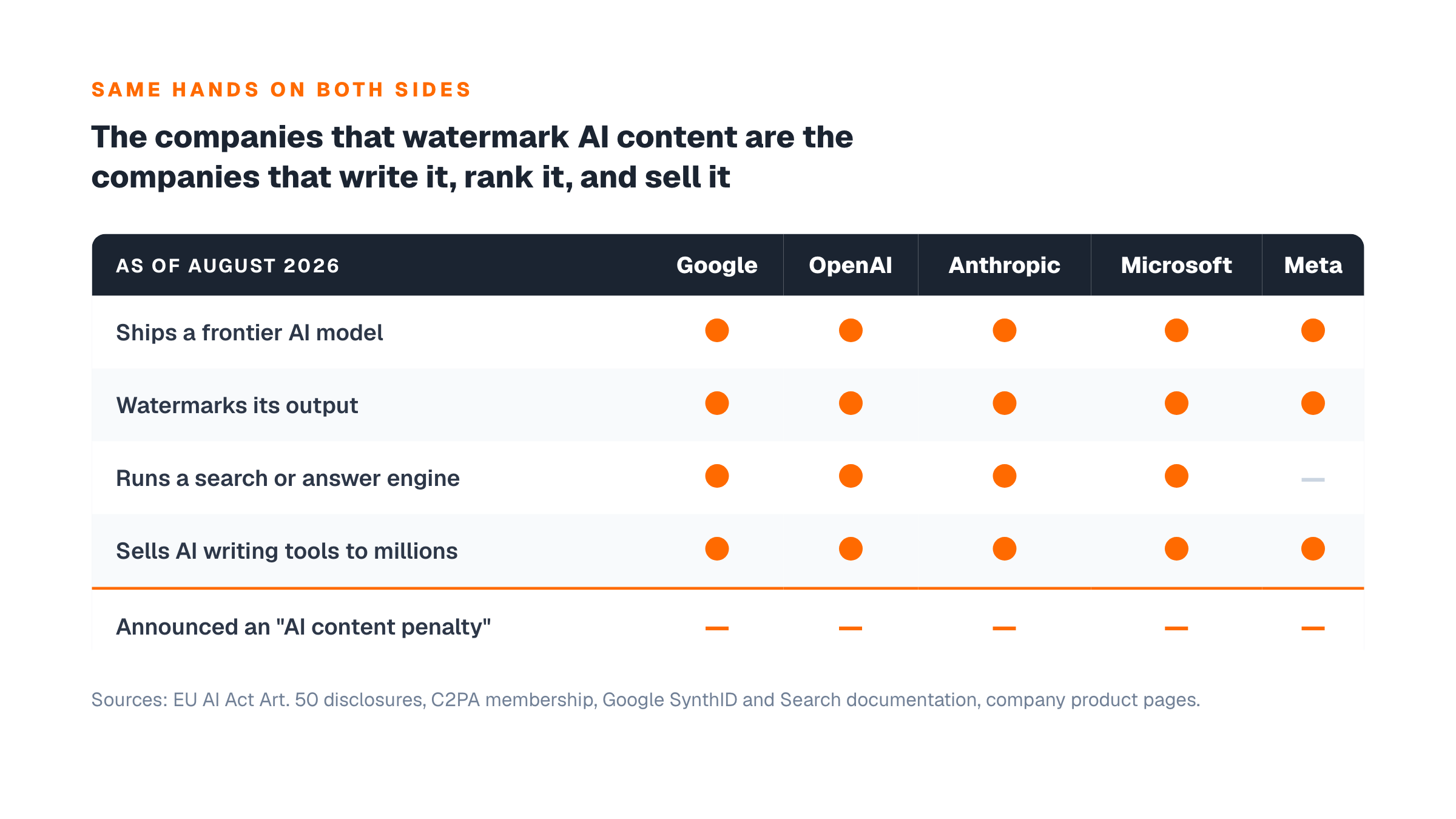
This is what Shahbaz means by the steering wheel. The watermark builders and the rankers are the same five companies. Their models write a growing share of the web. Their engines rank it. Their assistants cite it. An "AI penalty" would punish their own users, their own products, and, as the numbers above show, most of the useful web. The business case doesn't merely fail. It eats itself.
Google has been saying this in plain language for three years. Its official guidance, AI-generated content and Google Search, rewards high-quality content however it is produced. Search liaison Danny Sullivan has repeated the point on stage: the issue is the quality, never the tool, and good SEO for the AI era is still just good SEO. Watermarks upgrade detection capability. Ranking philosophy stays where it always was, because it never ran on authorship in the first place.
What actually gets penalized
None of this means nothing gets punished. Google's spam policies name the real target: scaled content abuse, meaning large volumes of low-value pages produced to manipulate rankings, and the policy is explicit that it applies whether that content was written by humans or by AI. The March 2026 core update reinforced it. Sites publishing thousands of raw, unedited AI drafts with no editorial oversight and no original information reported traffic collapses. Sites using AI as a drafting layer under real expertise did not.
The line was never human versus machine. The line is effort versus extraction.
What draws enforcement, and what doesn't
Relative enforcement risk (directional, based on documented policy and update patterns). What gets hit is scale without value, with or without AI.
Source: Google spam policies & documented enforcement patterns, 2024–2026
The "AI content is doomed" crowd tends to skip an uncomfortable symmetry here: a human content farm gets hit by the same policies. Low-value scaled content was penalized in 2011 with Panda, again in 2024 with the helpful content updates, and again in 2026. AI just made the abuse cheaper to attempt, and the enforcement more consequential when it lands.
So "will the mark hurt me" turns out to be the wrong question. The question that decided your visibility before watermarks existed, and will keep deciding it, is whether the page is worth retrieving and worth citing at all.
The bar that matters now is citeability
While marketers were arguing about watermarks, the definition of ranking quietly changed underneath them.
In AI search, your content doesn't win by appearing on a list of ten links. It wins by being selected as a source and quoted inside the answer itself. We've written about the signals that make content citable in depth, but a few findings from the citation research are worth carrying in your head.
Freshness dominates: 85% of AI Overview citations come from content published or updated within the last two years, and 44% from the current year alone. Authority compounds: the same 680-million-citation dataset shows answer engines leaning repeatedly on a small set of trusted, well-structured sources per topic. And getting named beats getting scraped: agency research puts the citation rate for brands named in answers at 53.1%, against 10.6% for brands whose content was retrieved without attribution.
What AI answers actually reward
Two patterns decide most of the outcome: engines cite fresh material, and being named in the answer converts far more visibility than being silently retrieved.
Source: Citation studies across AI Overviews, ChatGPT and Perplexity, 2025–2026
Put those findings together and the strategy writes itself. The ocean of interchangeable content never gets cited, because it adds nothing an engine can't get from a hundred other pages. What gets lifted out of the water is content with something scarce in it. Original data. A real position. First-hand expertise. A named entity behind the claims.
And here is the irony that should close the watermark debate for good: an invisible watermark removes none of those scarce qualities. If you run an original survey and use Claude to write it up, the survey is still original. Your expertise is still yours. The citation still lands. The mark in the word choices matters about as much as the brand of keyboard you typed on.
What to do about it, starting Monday
If you accept the argument so far, the to-do list gets refreshingly concrete.
Framework
The post-watermark content playbook
1. Keep using AI, deliberately. Draft, tighten, restructure, translate. The tool was never the risk. Publishing output nobody reviewed was.
2. Put something scarce in every piece. Original data, a tested opinion, first-hand experience, a named expert. If a page contains nothing another site couldn't generate in 30 seconds, skip publishing it.
3. Make it extractable. Open sections with self-contained answers, use clean structure and schema. The mechanics are in our citability guide.
4. Keep it fresh. With 85% of AI citations under two years old, updating your best pages beats publishing mediocre new ones.
5. Build the off-site record. Engines corroborate before they cite. Press, reviews, and third-party mentions are ranking inputs now.
6. And measure the thing that matters: whether AI systems actually name you. Nothing else on this list is verifiable without that.
One thing you won't find on that list is a watermark-removal tool. A cottage industry of "watermark strippers" appeared within days of Anthropic's announcement, which tells you a lot about who is afraid. Stripping a provenance mark does nothing to improve the page. It just hides how the page was made, and hiding how you work is the instinct of someone shipping content they suspect can't survive scrutiny. If your first reaction to the watermark news was to look for a way to launder the evidence, the watermark was never your problem.
The honest caveat
Two things could change this analysis, and it would be dishonest to leave them out.
Regulatory display requirements could evolve. The EU framework currently mandates machine-readable marking rather than user-facing labels on every surface. If future rules force a prominent "AI-generated" label in search results, click behavior could shift even while rankings stay put. The thing to watch is the regulation, not the algorithm.
Trust systems could also start using provenance as one input among many. It's plausible that engines eventually weigh provenance metadata in spam classification, as corroborating evidence when a site already shows scaled-abuse patterns. Even then, that would be a penalty on abuse with better forensics behind it. A brand that isn't running a content farm has nothing to fear from the distinction. A blanket demotion of most of the web, for the crime of using tools its rankers sell, remains implausible for every incentive reason above.
The bottom line
For anyone doing the work, the August 2026 watermark rollout is the biggest non-event in recent SEO memory. The marks are real. The compliance is real. The detection is real. The penalty is imaginary, because an AI penalty doesn't survive first contact with who builds the AI.
The divide that actually governs your visibility is older than watermarks and will outlive them. Useful content gets cited. Hollow content gets ignored. The only thing that changed is where the game is scored: inside AI answers now, instead of a list of blue links.
Which leaves one watermark question actually worth asking about your content, and no detector can answer it. When a buyer asks an AI who to trust, are you in the answer?
Find out, in about two minutes
Run a free scan and see exactly how ChatGPT, Claude, Gemini, Perplexity, and Google AI Overview answer your category's buying questions. Who gets named, who gets skipped, and where you stand.
Run My Free Visibility Scan →
FAQ
Does Google penalize AI-generated content in 2026? No. Google's published guidance rewards high-quality content regardless of how it was produced, and the largest independent study on the question, an analysis of 600,000 ranking pages, found a correlation of 0.011 between AI content share and ranking position, which is effectively zero. What Google does penalize is scaled content abuse: large volumes of low-value pages built to manipulate rankings, whether written by humans or machines.
Do AI watermarks affect SEO rankings? There is no evidence that watermarked content ranks differently, and no search or AI company has announced any ranking treatment tied to watermarks. Watermarks like Anthropic's and Google's SynthID exist for EU AI Act transparency compliance. They prove content was processed by a model, and rankings run on quality, originality, and expertise rather than authorship.
What does Anthropic's Claude watermark actually detect? A statistical bias in word choice indicating that text was processed by Claude. It survives copy-paste and light edits, and it may not survive heavy editing, translation, or short excerpts. It is also binary. It cannot distinguish a grammar pass on your own writing from fully generated text, and it says nothing about accuracy, effort, or value.
How much of the internet is AI-generated now? Roughly half of newly published English-language articles are primarily AI-generated, according to longitudinal article studies. Independent measurement found 74.2% of new pages contain at least some AI text, with 71.7% being a human-AI blend and only 2.5% purely AI. At the top of Google, 86.5% of ranking pages contain some AI content.
Will AI engines like ChatGPT refuse to cite AI-generated content? No. Answer engines select sources on relevance, freshness, authority, and structure. Research across hundreds of millions of citations shows no authorship filter, and AI systems cite AI-assisted content constantly. Content that fails to get cited fails because it offers nothing scarce, whoever wrote it.
Should I remove AI watermarks from my content? No. Stripping provenance marks does nothing to improve a page. If your content is genuinely useful and citeable, the watermark is irrelevant. If it isn't, removal won't save it. The same effort is better spent on originality, expertise, and structure.
What should content teams optimize for instead? Citeability, meaning being retrieved, trusted, and named inside AI answers. In practice: original data or perspective in every piece, extractable structure with schema, named expert authorship, freshness (85% of AI Overview citations are under two years old), an off-site record that corroborates your authority, and ongoing measurement of whether AI systems actually name your brand.
Want the citeability work done for you?
We build and run GEO programs for brands that want to be the answer instead of the ocean: original-data content, entity and schema architecture, and off-site authority.
Get a custom GEO plan →
Related reading: 4 Signals That Make Content Citable · GEO vs SEO · What Is AI Search Visibility? · How to Get Into Google AI Overviews